McKinsey 7S
Seven levers — strategy, structure, systems, style, staff, skills — all anchored to shared values, or execution stalls.
On this page
The gist
- →7S diagnoses why a company cannot execute a decided strategy: 7 elements (3 hard: Strategy, Structure, Systems; 4 soft: Shared Values, Style, Staff, Skills) must align.
- →Value comes from misfits, not description: state which pairs contradict, e.g. strategy asks for speed but Systems need three head-office approvals.
- →Anchor on a one-line strategy, map current vs target for each S, then rank the 3-4 binding gaps — usually an incentive or a decision right.
- →Sequence fixes: hard elements (incentives, metrics, decision rights) in a quarter; Skills, Staff, Shared Values take 1-3 years — with owners and metrics.
The framework at a glance
When to use it
Reach for 7S when the case is about the inside of the organisation rather than the market. Typical triggers: "Our client acquired a competitor last year and the integration is going badly — what should they look at?"; "The CEO announced a digital-first strategy 18 months ago and nothing has changed on the ground, why?"; "We are restructuring from a regional to a product-line organisation — will it work?"; "A family business is professionalising with outside CXOs and attrition has spiked"; "A PSU is being privatised — what has to change?"; "Post-turnaround, how do we make the cost discipline permanent?". It also fits public-sector, NGO and university reorganisation cases, and the implementation-risk or "what could go wrong" section at the end of any strategy case. Do not use it to size a market, diagnose falling profits or price a product — use profitability, market-entry or pricing structures for those, then bolt 7S on at the end if the interviewer asks how the recommendation will actually be implemented.
What it is
The McKinsey 7S framework is a diagnostic for the inside of a company. It was built in the late 1970s by McKinsey consultants Tom Peters, Robert Waterman and Julien Philips (with Richard Pascale and Anthony Athos) because managers of that era treated organisation design as an org-chart problem — who reports to whom. The 7S authors argued that structure alone explains almost nothing about why some firms execute and others do not. Instead, seven factors have to point the same way: Strategy (how the firm intends to win), Structure (how work and authority are divided), Systems (the processes, IT, budgets, metrics and incentives that run the place day to day), Shared Values (the beliefs people actually act on), Style (how leaders really behave, not what the values poster says), Staff (who is hired, developed, promoted and retained) and Skills (what the organisation is collectively good at). Shared Values sits in the middle of the classic diagram; the other six connect to it and to each other.
Keep reading ↓Show less ↑
The standard split is three hard elements and four soft ones. Strategy, Structure and Systems are hard: written down, visible, and directly changeable by a management decision — you can redraw the org chart on a Friday. Shared Values, Style, Staff and Skills are soft: nobody can decree them, they take quarters or years to move, and they are where most transformations quietly fail. The framework's central claim is that there is no hierarchy among the seven. A brilliant strategy sitting on top of systems that measure the wrong thing, or a structure that a legacy culture routes around, produces no result at all. McKinsey's own summary of the model puts it plainly: real progress in one part of the organisation is difficult without working on the others.
For a case interview, 7S is not a growth or profitability tool — it will not tell you why revenue fell or whether to enter a market. It is an internal, organisational lens. You reach for it when the question is why the company cannot execute what it has already decided to do, or what must change internally for a new strategy, merger or turnaround to actually stick. Used well, it converts vague answers like "they need to change the culture" into a specific list of misalignments — this incentive contradicts that strategy, this skill gap blocks that new system — each of which has an owner, a timeline and a fix.
How to apply it, step by step
- 1
Confirm this is an organisational question, not a market one
Say out loud why you are choosing 7S: the client has already decided what to do and the problem is that the organisation is not delivering it. If the underlying question is why profit fell or whether to enter a market, use a profit tree or market-entry structure instead and keep 7S in reserve for the implementation section. Picking the wrong lens is the fastest way to lose an interviewer.
- 2
Anchor on Strategy first, and write it in one sentence
Every other S is judged against the strategy, so make it explicit: win premium urban customers through same-day delivery, or become a full-service international carrier by 2027. If the interviewer has not given you a strategy, ask for it. That one-line statement is what later lets you say a particular incentive or reporting line is misaligned — misaligned with what, otherwise?
- 3
Describe the current state of all seven, briefly
Go through each S and capture what is true today in a phrase or two, using the interviewer's data and targeted questions. Useful probes: Structure — how many layers, who owns the P&L, where do decisions get stuck? Systems — what does the monthly review actually measure, how are bonuses computed, which IT systems do people work around? Style — do leaders decide by consensus or command, do they tolerate bad news? Staff — attrition, hiring source, average tenure? Skills — what can this firm do that rivals cannot, and what capability does the new strategy need that it lacks? Shared Values — what behaviour actually gets rewarded here?
- 4
Define the target state for each S implied by the strategy
For the strategy to work, what would each element have to look like? This is the step students skip, and it is where the analysis becomes useful. If the strategy is same-day delivery, target Systems include real-time inventory visibility and a daily rather than monthly ops review; target Skills include last-mile route optimisation; target Style is fast local decision-making instead of head-office sign-off.
- 5
Find the misfits — compare current to target, pair by pair
The seven elements give 21 pairs. Do not walk through all 21 out loud. Hunt for the three or four contradictions that clearly bite: an incentive that pays people to do the opposite of the strategy, a structure that hands responsibility without authority, a skill the plan assumes but nobody has, a leadership style that punishes the risk-taking the strategy needs. State each misfit with both sides in one sentence: Strategy asks for speed, but Systems require three head-office approvals for any discount.
- 6
Rank the misfits by how badly they block execution
Not all gaps matter equally. Rank on impact on the strategy multiplied by how binding the constraint is. Usually one or two are load-bearing — most often an incentive or a decision right — and the rest loosen once those move. Say which one you would fix first and why. This prioritisation is what separates a consultant's answer from a checklist recital.
- 7
Write the change plan: hard elements early, soft elements sustained
Sequence the fixes. Structure, decision rights, metrics and incentives can move in the first quarter and create the conditions for everything else. Skills, Staff and Shared Values need 12 to 24 months of hiring, training, promotion decisions and visible leader behaviour. Attach an owner, a timeline and one measurable indicator to each move, for example: Chief People Officer, Q2, share of frontline managers hired from outside the legacy business.
- 8
Name the risks and how you would know it is working
Close by naming what could derail it — attrition of key people, union resistance, the old culture reasserting itself once the transformation team leaves — and the leading indicators you would track monthly: engagement pulse scores, regretted attrition, cycle time on the decisions you just devolved, share of new-skill roles filled. Soft-element change is invisible unless you instrument it.
Worked example
Tata Sons acquires Air India from the Government of India in 2022 and sets a five-year plan to turn a loss-making state carrier into a world-class full-service airline, later folding Vistara, AirAsia India and Air India Express into two airlines. Eighteen months in, new aircraft are on order and the brand has been relaunched, but on-time performance and service complaints remain stubborn. Your client, the transformation office, asks: what actually has to change inside the airline?
Strategy — state it in one line
Become a profitable full-service global carrier able to compete with Emirates and Singapore Airlines internationally and IndiGo domestically, by expanding the fleet, consolidating four airlines into two (one full-service, one low-cost), and rebuilding the customer experience. Every other S now gets judged against this sentence.
Structure — current vs target
Current: a PSU-era hierarchy with many layers, silos between engineering, ground handling and in-flight, and decisions escalating to the top — overlaid with four merging airlines each carrying its own reporting lines. Target: two clean business units with single accountable P&L owners, and station managers empowered to resolve delays without head-office sign-off. Misfit: responsibility for on-time performance is spread across three functions and owned by none.
Systems — current vs target, and the top priority
Current: legacy government-era procurement and approval processes, fragmented IT across the merged carriers, and reporting cycles built for compliance rather than operations. Target: unified reservation, crew-rostering and maintenance systems; a daily operational review with one on-time-performance number; manager incentives tied to customer metrics. Misfit and first fix: nobody is paid on OTP or NPS, so no amount of exhortation will move them. Systems is the load-bearing gap.
Shared Values — the real battleground
Current: decades of PSU norms — job security regardless of performance, seniority over merit, the customer treated as a given rather than a choice. Target: the Tata service ethic, where a complaint counts as a failure and frontline initiative is safe. Misfit: cabin and ground staff have never been rewarded for discretionary effort, so a brand relaunch is paint over unchanged behaviour. This shifts only through what leaders visibly reward, not through posters.
Style, Staff and Skills
Style: command-and-control and risk-averse; target is leaders who devolve decisions and receive bad news without blame. Staff: voluntary retirement schemes shrank the legacy workforce while thousands of new cabin crew and pilots were hired on fixed-term contracts, creating two workforces with different expectations on the same aircraft — a serious integration risk. Skills: deep technical and engineering capability, but weak in premium service delivery, revenue management and digital customer journeys, all of which the strategy assumes. Skills is the second binding constraint after incentives.
Prioritised change plan
Quarter 1 to 2, hard elements: appoint one accountable owner for on-time performance per station; devolve delay-resolution authority; run a daily ops review on a single OTP number; rewire manager bonuses to OTP and NPS. Year 1 to 2, soft elements: a common service academy training legacy and new crew together; harmonise contracts and grades so the two workforces converge; promote a first cohort of visibly merit-selected managers; codify leadership behaviour and review it in 360s. Track monthly: OTP, NPS, regretted attrition among new hires, and the share of delay decisions resolved at station level.
Takeaway: The aircraft order and the brand relaunch are Strategy, and at best Structure. Air India's execution gap sits in Systems (nobody is measured or paid on on-time performance), Skills (no premium-service muscle) and Shared Values (PSU-era norms versus a service culture). Fix incentives and decision rights first because they are cheap and fast, then spend two years on skills and culture — reversing that sequence is exactly why most transformations stall.
More worked examples
Worked example: Microsoft's 2014-2019 turn to the cloud under Satya Nadella+
In February 2014 Satya Nadella takes over a Microsoft that is highly profitable but strategically stuck: Windows and Office licences fund everything, the Nokia handset deal has just closed, and Amazon Web Services is running away with the cloud market. He declares a mobile-first, cloud-first company whose mission is to empower every person and organisation on the planet to achieve more. Five years later Azure and Office 365 are the growth engine and the market capitalisation has gone from roughly 300 billion dollars to around 1 trillion. The interviewer's question: the strategy statement changed on day one, so what actually changed inside the company to make it stick? Run 7S on the pre-2014 organisation.
Market cap, 2014 to 2019
~$300B to ~$1T (approx.)
Nokia devices write-off, 2015
~$7.6B
Job cuts announced, July 2014
~18,000 (~14% of staff)
Commercial cloud ARR goal
$20B by FY2020 (hit early)
LinkedIn / GitHub buys
~$26B (2016) / ~$7.5B (2018)
Strategy - state it in one line, and name what it replaces
Target strategy: win the enterprise by selling metered cloud capacity and per-seat subscriptions that run on any device and any operating system, including rivals' ones. This is not a tweak of the old devices-and-services strategy, it is its inversion: the old plan monetised a Windows endpoint once, the new one monetises consumption forever and is indifferent to the endpoint. Two consequences fall out immediately and every other S gets judged against them. First, revenue becomes recognised over time rather than at licence sale, so the whole reporting and comp machinery is measuring the wrong event. Second, Windows stops being the product every other product must serve, which is a shared-values problem long before it is an org-chart problem.
Systems - the load-bearing misfit, and the one everyone forgets
Pre-2014 the field salesforce was paid on on-premises licence billings and seat renewals, so a rep who moved a customer to Azure consumption was voluntarily taking a pay cut. That single incentive line was strong enough to defeat the CEO's strategy indefinitely, which is why comp was rewired to cloud consumption and customer-success measures rather than licence bookings. Alongside it, the performance-review system, the stack-ranked forced curve, actively punished the collaboration an integrated cloud stack requires: if only a fixed share of my team can be rated top, helping the Azure team is a rational thing to refuse. Microsoft scrapped stack ranking and rebuilt reviews to give explicit credit for building on others' work and contributing to others' results. The external reporting system changed too, disclosing commercial cloud annualised run-rate against a public 20 billion dollar FY2020 target, which forced the internal review cadence onto the same number.
Structure - what moved and what deliberately did not
Nadella largely kept the functional One Microsoft structure inherited from Ballmer's 2013 reorg rather than restoring divisional P&Ls, because divisional P&Ls would have re-created the incentive for each unit to protect its own Windows-attached revenue. What did change was where the cloud sat: Azure was pulled out from under a server-software P&L into a top-line reported segment with a single accountable leader, so it competed for investment on its own growth rather than as a line item inside a mature licence business. The most telling structural act came in the March 2018 reorg, which dissolved the standalone Windows division and split its people into the cloud-and-AI and the experiences-and-devices groups. Structure was used here as a signalling device: as long as a Windows organisation existed with its own leader and targets, every cross-platform decision had an internal opponent.
Shared Values and Style - growth mindset as an operating change, not a poster
The stated value shift was from know-it-all to learn-it-all, borrowed from Carol Dweck's growth-mindset work, with empathy and customer obsession attached. The reason it was not empty is that the leader's observable behaviour changed in ways employees could price. Nadella put Office on the iPad in March 2014, held up an iPhone on stage, took Microsoft into the Linux Foundation in 2016 and open-sourced meaningful parts of the stack, each of which said the Windows-first reflex was genuinely dead. Senior leadership meetings were re-anchored on customer research rather than internal scoreboards, and public failures such as the Tay chatbot were handled as learning rather than as blame. In 7S terms, Style is the cheapest and fastest lever a CEO controls and it is how Shared Values actually move, because staff infer values from what leaders reward and tolerate, not from what is written down.
Staff and Skills - the capability the strategy assumed and the company did not have
Microsoft was world-class at packaged software engineering, enterprise licensing and channel partners, and genuinely weak at three things the cloud strategy required: operating global datacentres at scale, engineering as continuous deployment rather than three-year ship cycles, and a selling motion based on driving consumption after the sale instead of closing a renewal. Staff moves were surgical rather than wholesale at the top, an insider CEO of 22 years, a refreshed leadership team including a new CHRO in 2014 and the cloud engineering leadership consolidated under one executive, while the Nokia handset workforce was cut in the roughly 18,000 reduction of July 2014 and the deal written off at about 7.6 billion dollars in 2015. Skills that could not be grown fast enough were bought: LinkedIn for around 26 billion in 2016 brought a data asset and a consumer-scale engineering culture, GitHub for about 7.5 billion in 2018 bought credibility with the developer population Microsoft had spent a decade alienating. Note the pattern for an interview: acquisitions here are a Skills and Staff intervention, not a Strategy one.
Sequence - what had to happen before what
The hard elements went first because they are fast and they gate everything else: fix sales comp so the strategy is not personally costly to the people executing it, kill the forced curve so collaboration is not punished, and publish one cloud number that the monthly business review runs on. Only then does the soft work pay off, because a growth-mindset programme launched on top of stack ranking would have been read, correctly, as theatre. Structure was used sparingly and late, with the Windows division dissolved four years into the transition once the cloud business was large enough to absorb it without a revolt. The soft elements, values and the cross-platform reflex, took the full five years and were the constraint on total speed, which is the general lesson: hard elements move in quarters, soft elements move in years, so start the soft work early even though it finishes last.
Takeaway: Nadella did not win by announcing a better strategy - a cloud-first strategy was obvious and Ballmer had already funded Azure. He won by removing the internal contradictions that made the old strategy self-enforcing: a comp plan that paid people to sell the past, a review system that made cooperation irrational, and a Windows-first value that vetoed every cross-platform decision. The 7S lesson is that when a strategy has been announced and nothing has moved, the answer is almost never a new strategy - look at Systems (what gets measured and paid) first, then at what leaders visibly reward, and use Structure as a signal rather than as the fix.
Worked example: Indian case interview - a family-owned packaged-foods company that cannot go modern trade+
Your client is a 38-year-old family-owned packaged snacks and namkeen company headquartered in Rajkot, roughly 1,800 crore rupees of revenue (illustrative), strong in Gujarat and Maharashtra general trade through about 450 distributors and a few lakh kirana outlets. Eighteen months ago the promoter family hired its first professional CEO from a large FMCG multinational, who announced a plan to take modern trade, e-commerce and quick commerce from 12 percent of revenue to 35 percent in three years, funded partly by a pre-IPO round. Today that share is 15 percent, quick-commerce fill rates are around 72 percent against a 95 percent service-level obligation, three of the five newly hired CXOs have already resigned, and the promoter is asking whether the professionalisation was a mistake. The board wants to know what has to change inside the company before it commits any more capital.
Revenue (illustrative)
~Rs 1,800 cr
MT + e-com + QC share
12% today vs 35% target in 3 yrs
Quick-commerce fill rate
~72% vs 95% SLA (approx.)
Channel margin ask
GT ~10% vs QC ~28-32% all-in (est.)
New CXO attrition
3 of 5 in 18 months
Confirm the lens, then write the strategy in one sentence
Say it out loud: the client is not asking whether to enter modern trade, that decision is made and funded, so a market-entry or profitability tree answers the wrong question. The question is why an approved strategy has produced three percentage points of channel shift in eighteen months, which is an internal execution question, so 7S is the right structure. One-line strategy to anchor on: become a national packaged-foods brand where roughly a third of revenue comes from modern trade, e-commerce and quick commerce within three years, without losing the general-trade base that funds it. Everything that follows gets judged as aligned or misaligned against that sentence, and note the trap built into it - the old channel pays today's salaries, so any misfit will resolve in favour of general trade unless something is changed deliberately.
Systems - the misfit that explains most of the gap
Ask three questions: what is the sales incentive paid on, what does the monthly review discuss, and can the company see profit by SKU by channel. Typically in this company the answer is that 100 percent of the field incentive is on primary billing to distributors, the monthly review is a dispatch-versus-target meeting held around day 20, and the finance stack is Tally plus spreadsheets with no SKU-level channel contribution. Each of those independently kills the strategy: a regional sales manager whose bonus depends on stuffing distributors will not chase a Blinkit fill rate, a monthly dispatch review cannot manage a channel that replenishes dark stores every 48 to 72 hours, and without SKU-by-channel margin nobody can tell that the 10-rupee pack, which works at a 10 percent general-trade margin, is loss-making once a roughly 28 to 32 percent all-in quick-commerce margin, listing fees, visibility spend and returns are loaded on. The fix is unglamorous and fast: split incentives into primary, secondary and channel fill rate, move to a weekly service-level and on-shelf-availability review, and build a SKU-by-channel contribution view before spending another rupee on listings.
Structure - who owns the new channel, and who owns the conflict
Current state is a single national sales head under whom regional managers own a geography and every channel inside it, so the quick-commerce account is serviced by the same manager whose target is distributor billing in that state. That guarantees the new channel gets whatever attention is left over, and it also means nobody owns the two things quick commerce actually runs on, fill rate and the dark-store replenishment plan. Target structure is channel-based at the top: a modern-trade and e-commerce vertical with its own P&L, dedicated key-account managers per platform, and a supply-chain node that ships to platform warehouses on a separate cycle from the distributor cycle. The predictable objection, that this creates channel conflict on price, is real and should be named: general trade will see quick-commerce discounting as margin theft, so the structure has to come with a channel-pricing and pack-architecture rule, for example different grammage or bundle packs for quick commerce so the kirana is not directly undercut on the same SKU.
Style and Shared Values - why three CXOs left
This is the part students skip and it is the actual answer to the board's question. The stated value set is family, loyalty, frugality and long relationships with distributors, several of whom have been with the promoter for 25 years and speak to him directly. The observed style is that decisions taken in the CXO meeting get reversed informally afterwards, often after a distributor calls the promoter, so the new chief sales officer discovers that his channel-pricing decision was overturned without him being in the room. Frugality compounds it: trade and visibility spend is treated as leakage rather than investment, which is survivable in general trade where the distributor funds working capital, and fatal in quick commerce where visibility spend is the price of entry. The misfit is not that the CXOs were weak, it is that they were given accountability without decision rights, and capable lateral hires leave that situation within roughly a year, which is exactly what happened.
Staff and Skills - two workforces and three missing capabilities
On Staff, the company now runs two populations on the same floor: multinational hires on roughly two to three times the pay of the incumbents they manage, and 15-to-20-year loyalists on legacy grades with no written job descriptions, which produces resentment downward and isolation upward. On Skills, list what the strategy assumes and the firm does not have: key-account management for platform buyers, revenue growth management to design pack-price architecture per channel, demand planning tight enough to replenish dark stores on a 48-hour cycle, and performance marketing for the direct-to-consumer piece. What the firm is genuinely world-class at - taste, low-cost manufacturing, and a distributor network that would take a competitor a decade to build - is not on the list of what the new strategy needs, which is precisely why the transformation feels alien to the people who built the company. Any plan that does not explicitly protect and honour the general-trade engine while building the new muscle will be sabotaged quietly, and interviewers reward candidates who say that out loud.
Prioritised plan and the metrics you would put on one page
Quarters 1 and 2, the hard and cheap moves: publish a written delegation-of-authority matrix with the promoter's signature on it and move him to a chair role with defined reserved matters, carve out the modern-trade vertical with its own P&L and key-account managers, rewire field incentives to a 60-30-10 split across primary, secondary and channel fill rate, and stand up a SKU-by-channel contribution report even if it starts in Excel. Quarters 2 to 4, the systems build: a distributor management system for secondary-sales visibility, a weekly fill-rate and on-shelf-availability review chaired by the CEO, and a channel pack-price architecture that separates quick-commerce SKUs from kirana SKUs. Year 1 to 2, the slow soft work: harmonise grades and pay bands so the two workforces converge, run a joint capability programme so legacy managers can move into the new channel rather than being displaced by it, and promote one visible internal person into the modern-trade vertical to prove the path exists. Track five numbers monthly - MT plus e-commerce revenue share, quick-commerce fill rate, contribution margin per SKU per channel, general-trade secondary sales to prove the base is not being cannibalised, and regretted attrition in both the new and legacy populations.
Takeaway: The strategy was fine and the CXO hires were not the problem - the plan died because Systems paid everyone to keep selling to distributors, no one could see that the flagship SKU loses money in quick commerce, and Style let the promoter reverse the decisions he had delegated. Fix decision rights, incentives and the SKU-by-channel P&L in two quarters because they are nearly free, then spend eighteen months on capability and pay-grade harmonisation. The general 7S point for an Indian professionalisation case: the binding constraint is almost always the promoter's informal authority meeting a formal org chart, and no amount of senior hiring fixes it until decision rights are written down and visibly honoured.
Common pitfalls
- •Listing all seven elements with one generic sentence each and stopping there. The value of 7S is not the description, it is the misfit — you must say which pairs contradict each other and which contradiction blocks the strategy most.
- •Using it as a general-purpose structure. Interviewers regularly see candidates deploy 7S on a profitability or market-entry case because it looks sophisticated. It contains no revenue, cost, customer or competitor dimension, so it cannot answer those questions and it signals pattern-matching instead of thinking.
- •Treating Structure as the answer. Redrawing the org chart is the easiest move and the one most likely to change nothing. If Style, Staff, Systems and Shared Values are untouched, the new boxes will reproduce the old behaviour within two quarters.
- •Confusing Shared Values with the values statement on the website. Shared Values are what people actually believe and what actually gets rewarded. If the poster says customer first but the bonus pays on volume, the real shared value is volume — say so out loud.
- •Ignoring sequencing and time. Hard elements can move in a quarter; Skills, Staff and Shared Values take one to three years. An answer promising a culture change by next quarter is not credible, and one with no timeline at all is not a plan.
- •Being descriptive rather than prescriptive. 7S is a diagnostic, not a recommendation. You still have to convert the misfits into a ranked change plan with owners, timelines and metrics, or the interviewer asks so what and you have nothing.
Interview tips
- •Signpost the choice before you use it: this is an execution problem rather than a market problem, so I would like to look inside the organisation across seven elements, three structural and four cultural. Explaining why you chose the lens earns more than naming the framework.
- •Never recite all seven in order without a hypothesis. Cover them quickly, then say I believe the binding constraints are Systems and Skills, may I go deeper there. Depth on two elements beats a lap around all seven.
- •Prepare one crisp misfit sentence template and reuse it: the strategy requires X, but the current [element] rewards or enables Y. Three of those in a row sounds like a consultant rather than a student.
- •Get quantitative even though the framework is qualitative. Ask for attrition rate, span of control, number of approval steps, time-to-decision, engagement scores, share of revenue from the new strategy. Numbers turn a soft answer into an evidence-based one.
- •Pair it deliberately with other tools. 7S diagnoses the gaps; Kotter's 8-step sequences the change; a RACI or stakeholder map assigns the fixes; a balanced scorecard instruments them. Saying you would use 7S to find the misalignments and Kotter to sequence the change shows framework judgement, not framework recall.
- •Keep two India examples ready — a post-merger integration (Air India and Vistara, or HDFC Bank and HDFC Ltd) and a family business professionalising with outside CXOs. Indian offices reward candidates who ground the abstraction in a company the panel actually follows.
Test yourself
Best video explainers
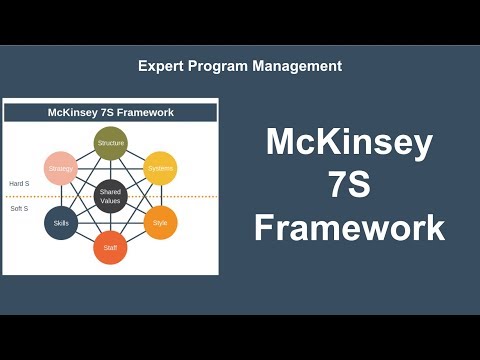
McKinsey 7S Framework Explained
EPM
Clean, well-produced walkthrough from a respected project and change-management channel — the best single starting point if you have never seen the model.

McKinsey 7S Framework | From A Business Professor
Business School 101
A business professor covers each element with company examples and the model's limitations, which is the level of nuance interviewers probe for.
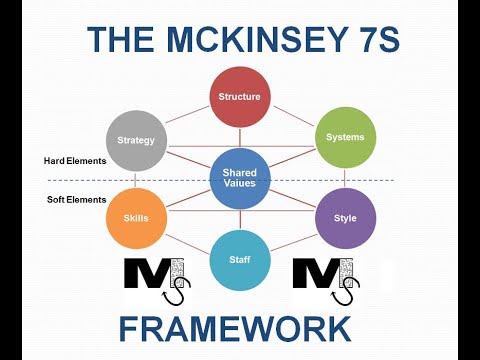
The McKinsey 7S Framework - Simplest Explanation Ever
Mister Simplify
Short and unusually plain-spoken — a good refresher the night before an interview.

The Mckinsey 7s Framework Model | Explained in Detail for BBA / MBA / B.Com
Study Practically
Built for the Indian BBA and MBA strategic-management syllabus, so the vocabulary and framing match what Indian B-school students are taught.
McKinsey 7s framework with company examples / strategic management
Management by Dr. Mitul Dhimar
Works the seven elements through real company examples — the jump from definition to application that most students struggle with.
Go deeper
The McKinsey 7-S Framework
Mind Tools
The most practical version — gives you the diagnostic questions to ask under each element, which is exactly what you need mid-case.
McKinsey 7S Model: The 7S Framework Explained
Strategic Management Insight
Detailed free explainer with a five-step application process and a worked startup-growth case showing how alignment breaks as a company scales.
The McKinsey 7-S Model: Definition, Pros and Cons
Prosci
Written from a change-management practitioner's view and honest about the model's weaknesses — useful for answering what are the limitations of this framework.
McKinsey 7S Framework
Wikipedia
Reliable on the origin story (Peters, Waterman, Philips, Pascale, Athos and In Search of Excellence) and the hard-versus-soft split, with references to follow.
Now use it on a real case
Reading a framework isn't the same as applying it under pressure. Practise with an AI interviewer that pushes back.
Practise a case free