Kotter's 8-Step Change Model
The playbook for making change actually stick — because most transformations fail on people, not strategy.
On this page
The gist
- →8 steps in 3 phases: create the climate (urgency, coalition, vision), engage and enable (volunteers, barriers, wins), make it stick (accelerate, culture)
- →Transformations fail on people, not strategy: broken incentives, KRAs and approval workflows kill change, so steps 5-6 carry the consulting substance
- →Engineer a visible win in 6-12 months and have the converted sceptic present it; declaring victory after that first win is Kotter's most damaging error
- →Use it for execution and adoption problems (stalled ERP, post-merger integration, family-to-professional shift), never for analytical questions like pricing
The framework at a glance
When to use it
Reach for Kotter when the case is about getting people to behave differently, not about what the right answer is. Typical triggers: "We designed the new operating model but adoption is 20% after nine months"; "Our client just acquired a competitor and the two sales forces refuse to cross-sell"; "The promoter wants to move a family-run manufacturer to professional management"; "The ERP or CRM went live but reps still use spreadsheets"; "We are shutting three plants and consolidating into one"; "A PSU bank is digitising branch operations and the union is resisting"; or any turnaround where the diagnosis is agreed and the question is execution. Also use it as the back half of an answer — after you recommend a market entry, pricing overhaul or cost programme, the likely follow-up is "how would you actually implement this?" and Kotter is the cleanest structure for that. Do not use it when the question is analytical (why did profits fall, what should we price at); there you need profitability, pricing or a market-sizing structure instead.
What it is
Kotter's 8-Step Change Model is a sequence for leading large-scale organizational change. Harvard professor John Kotter built it from a decade-long study of more than 100 companies attempting transformation, published first as the 1995 HBR article "Leading Change: Why Transformation Efforts Fail" and then as the 1996 book Leading Change. His finding was blunt: most transformations fail, and they almost never fail because the strategy was wrong. They fail because leaders skip steps in the human side of change — they announce a restructuring before anyone believes there is a problem, or they declare victory after one good quarter and watch the old behaviour creep back.
Keep reading ↓Show less ↑
The eight steps are: create a sense of urgency, build a guiding coalition, form a strategic vision, enlist a volunteer army (originally "communicate the vision"), enable action by removing barriers, generate short-term wins, sustain acceleration, and institute change in the culture. Kotter groups them into three phases. Steps 1 to 3 create the climate for change — they answer why now, who leads, and where we are going. Steps 4 to 6 engage and enable the organization — they answer who does the work, what is blocking them, and how we prove it works. Steps 7 and 8 make it permanent — they answer how we keep going and how we stop it unravelling. The order matters because each step manufactures the raw material the next one consumes: urgency buys you a credible coalition, the coalition writes a vision people believe, the vision recruits volunteers, and short-term wins buy the political capital to attack the hard structural work later.
Kotter revised the model in his 2012 HBR article and 2014 book Accelerate. There he renamed the steps "accelerators" and made three changes worth knowing. First, the eight run concurrently and continuously, not as a linear checklist you tick off. Second, change should be driven by a large volunteer network drawn from across the organization, not a small task force appointed from the top. Third, he proposed a "dual operating system" — the traditional hierarchy keeps running the business efficiently while a parallel, network-like structure drives the change. If you cite the model in an interview and add the Accelerate update, you signal that you have read past the textbook summary.
How to apply it, step by step
- 1
Manufacture urgency with data, not adjectives
Kotter's threshold is roughly 75% of the leadership team genuinely convinced the status quo is more dangerous than change. In a case, do this with a number the client cannot argue with: an order book down 30%, a competitor's cost per unit 18% lower, churn up 400bps. Contrast the burning platform (what breaks if we do nothing) with the big opportunity (what we win if we move now) — people move faster toward opportunity than away from fear. Complacency, not open opposition, is the real enemy at this step.
- 2
Build a guiding coalition with power, credibility and expertise
Name actual roles, not 'senior leadership'. A good coalition has line authority (someone who controls budget and headcount), functional expertise (the plant head or tech lead who knows what is actually possible), and informal credibility (the 20-year veteran everyone trusts). Deliberately include one respected sceptic — converting them is worth more than ten enthusiasts. State whether the CEO sponsors it, who chairs it, how often it meets, and what it can decide without escalation.
- 3
Write a vision short enough to say in 60 seconds
Kotter's test: if you cannot explain the vision in under five minutes and get interest, it is not done. Make it directional and concrete — '40% of revenue from EV components by FY30, from 4% today' beats 'become a future-ready mobility partner'. Pair the vision with a strategy: the three or four big moves that get you there. In a case, offer one draft sentence out loud; interviewers reward that specificity far more than an abstract description of what a vision should contain.
- 4
Communicate relentlessly and enlist volunteers
Kotter's original finding was that leaders under-communicate the vision by a factor of ten. Specify channels and cadence: monthly town halls, a weekly one-pager, a vernacular WhatsApp broadcast for shop-floor supervisors, cascade decks managers must use in team meetings. The more important half is that leaders must model the behaviour — a cost programme dies the day the MD's business-class ticket is spotted. Recruit a volunteer network of 50 to 200 champions across levels rather than relying on a 10-person PMO.
- 5
Remove the barriers people are actually hitting
Ask front-line staff what stops them, then fix structural causes: incentive plans that still pay on the old metric, an approval workflow with nine sign-offs, a legacy system that will not talk to the new one, job descriptions written for the old model. This is where most transformations quietly die — the vision says one thing and the appraisal form says another. If a senior manager is actively blocking, the coalition must confront or move them; ignoring it tells everyone the change is optional.
- 6
Engineer short-term wins in 6 to 12 months
Do not wait for wins — design them. Pick something visible, unambiguous, and clearly caused by the change effort: one pilot line, one region, one customer segment. Make the target achievable and the measurement airtight, then publicise it and reward the people involved. Wins fund the effort politically: they convert fence-sitters, silence critics, and give the coalition credibility to attack the harder structural work in step 7.
- 7
Sustain acceleration — do not declare victory early
Kotter's most-cited warning is that celebrating too soon lets the old culture reassert itself. After the first wins, increase the pace: use the credibility to change systems and structures that never fit the vision (org design, incentive schemes, hiring criteria, budgeting cycles), launch the next wave of projects, and bring in new change agents. Kotter's rule of thumb is that real transformation takes 3 to 7 years, not one budget cycle.
- 8
Anchor the change in culture last, not first
Culture changes only after new behaviours have produced visible results and people connect the two. Hard-wire it: rewrite KRAs and bonus formulas, change what gets asked in hiring interviews and promotion committees, retrain onboarding, and plan succession so the next leader is a believer. State the metrics you will still be tracking two years out — that is the difference between a project and a permanent change.
Worked example
Sanghvi Auto Components is a Pune-based, family-run Tier-1 supplier with revenue of about 4,000 crore rupees and 6,000 employees across four plants. Roughly 85% of revenue comes from internal-combustion engine parts — crankshafts, fuel injection housings, exhaust manifolds. Two OEM customers have just told the company that their India EV volumes will be 30% of output by FY30, and the FY26 ICE order book is already down 9%. The board approved a pivot to EV components (busbars, battery enclosures, e-axle housings) and a 600 crore rupee capex plan. Nine months in, the pivot is stalling: the EV business unit has 12 people, sales is still chasing ICE tenders, and the Chakan plant head has quietly deprioritised the pilot line. The CEO asks a consulting team why, and what to do.
Step 1 — Create urgency
Right now the shop floor believes EVs are a Delhi headline, not a Pune reality. The team builds a one-page fact base: the two OEM letters, the 9% order-book decline, and a projection that at current trends 55% of Sanghvi's ICE revenue is at risk by FY31 while EBITDA falls from 14% to 6%. It is presented plant by plant, not just to the board. The opportunity half matters equally: the same OEMs have indicated a 1,200 crore rupee addressable EV component spend for which Sanghvi is pre-qualified. Target: every plant head and the full leadership team saying out loud that doing nothing is the riskier option.
Step 2 — Build the guiding coalition
The current EV unit head is a 34-year-old outside hire with no line authority — that is the root problem. The new coalition is chaired by the promoter-MD (power and family legitimacy) and includes the COO who controls plant capex, the Chakan plant head (the sceptic, deliberately included and given the pilot to own), the head of OEM sales, the CHRO, and a respected 22-year veteran production engineer the supervisors trust. It meets every Monday for 90 minutes with decision rights over capex releases.
Step 3 — Form the strategic vision
Drafted in one line: 'By FY30, 40% of Sanghvi's revenue comes from EV and platform-agnostic parts, and no employee loses their job to the transition — they get retrained.' The second clause does heavy lifting, because the biggest unspoken fear on the shop floor is redundancy. The strategy is three moves: convert Chakan Line 3 to busbars, acquire or license battery-enclosure welding capability, and reskill 800 machinists over 24 months.
Steps 4 and 5 — Enlist the army and remove barriers
A volunteer network of 120 champions (supervisors, quality engineers, union representatives) is recruited and trained, with monthly gemba walks and Marathi and Hindi WhatsApp broadcasts for the shop floor. Then the real barriers get fixed. The sales incentive plan pays purely on tonnage shipped, which structurally penalises low-tonnage EV parts — it is rebased to gross margin with a 1.5x multiplier on EV wins. Plant head KRAs, previously 100% ICE OEE, get a 20% EV-readiness component. Capex approval for EV tooling moves from nine signatures to a single coalition sign-off under 5 crore rupees.
Step 6 — Generate short-term wins
Rather than waiting for the full 600 crore rupee programme, the team targets one visible win in eight months: Chakan Line 3 converted to busbar production, PPAP approval from OEM A, first commercial shipment. It lands 42 crore rupees of annualised revenue at 19% gross margin against the ICE average of 12%. The margin number is the message. It is announced at every plant, the line's 40 operators are publicly recognised and given a retention bonus, and the Chakan plant head presents it — converting the loudest sceptic into the programme's most credible advocate.
Step 7 — Sustain acceleration
The coalition spends that credibility on work it could never have won approval for in month one: a standalone EV business unit with its own P&L, a battery-systems engineering head hired from outside the auto-components industry, the Aurangabad plant's second shift moved to platform-agnostic parts, and two long-term ICE contracts renegotiated with sunset clauses instead of auto-renewals. Two further waves of pilots launch in parallel. Nobody uses the word 'done'.
Step 8 — Anchor in culture
EV revenue share becomes the standing first slide in the monthly business review and a board KPI. Engineering hiring criteria shift toward power electronics and thermal management. The ITI apprentice programme adds an EV module, and 800 machinists move through a reskilling academy with certification tied to grade progression. The promoter's succession plan explicitly names EV-transition delivery as a criterion for the next MD. The change now survives the person who started it.
Takeaway: The strategy was never wrong — the board approved the right pivot. It stalled because incentives, KRAs and approval workflows all still rewarded the old business, and because nobody on the shop floor believed the threat was real yet. Kotter's value in a case is that it points you at those structural and belief-level blockers instead of at the strategy deck, and tells you to buy political capital with an engineered early win before attacking the hard stuff.
More worked examples
Worked example: Adobe moving from Creative Suite boxes to Creative Cloud subscriptions (2011-2015)+
Adobe sold Creative Suite as a perpetual licence — you paid roughly 1,300 to 2,600 US dollars once, owned it forever, and upgraded when a new version shipped every 18 to 24 months. That model produced lumpy, release-driven revenue, left most of the installed base running two-generation-old software, and made piracy easy. Revenue had plateaued around 4 billion dollars while cheaper and freemium tools nibbled at the low end. In 2011 Adobe launched Creative Cloud alongside the boxes, and at Adobe MAX in May 2013 CEO Shantanu Narayen's team announced CS6 was the last perpetual release — everything future would be subscription only. Customers revolted, revenue fell for two years, and the change still worked. All figures below are public-record approximations, not audited statements.
Perpetual CS price (approx)
$1,300-$2,600 one-time
Creative Cloud entry price
$49.99/mo full suite; $9.99/mo photography plan
Revenue trough (approx)
~$4.4bn FY12 to ~$4.06bn FY13
Paid CC subscribers (approx)
~1.4M end FY13 to ~3.4M end FY14
Customer backlash
tens of thousands of petition signatures, 2013
Step 1 - Create urgency (the burning platform was invisible from inside a profitable business)
Adobe was not losing money. That is exactly the complacency Kotter warns about — no crisis, no urgency, no change. The urgency had to be manufactured from structural facts: revenue was flat around 4 billion dollars for several years, roughly half the paying installed base was running an old version because the upgrade decision was a 1,300 dollar re-purchase every two years, piracy meant a large share of actual users paid nothing, and the entire year's number depended on whether one big release landed well. Narayen's framing was not 'we are dying', it was 'the model caps us' — the opportunity half of urgency. If you own the customer relationship monthly instead of biennially, you learn what they use, you can ship continuously, and you convert the students and freelancers who were never going to pay 2,600 dollars upfront.
Step 2 - Build the guiding coalition (the non-obvious member is the CFO)
Most students would put the product leader at the centre. The binding constraint here was accounting, so the coalition's most important member after Narayen was CFO Mark Garrett. Under revenue recognition rules, a 1,300 dollar licence books immediately while a 49.99 dollar subscription books over 12 months — so a successful transition looks identical to a collapsing business for about two years. Garrett's job was to build and pre-sell a second scoreboard before the numbers went negative. The coalition therefore spanned CEO, CFO, investor relations, David Wadhwani's digital media product organisation, and sales leadership — and it had a second, external audience the coalition had to convert: sell-side analysts and large institutional holders, who could kill the programme by punishing the stock hard enough to force a reversal.
Step 3 - Form the strategic vision
The one-line version: every creative on the latest version, all the time, connected. Concrete and directional, not 'become a cloud-first company'. The strategy underneath was three moves. One, kill perpetual entirely rather than run both models — a hybrid would have let sales and customers stay on the old rails indefinitely, which is precisely how transformations die. Two, price to widen the funnel: 49.99 a month drops the entry barrier from a 2,600 dollar capital decision to a credit-card decision, and the later 9.99 photography plan pulled in a long tail that Creative Suite never monetised. Three, change the scoreboard to annualised recurring revenue, subscriber count and churn.
Steps 4 and 5 - Enlist and remove barriers (four real blockers, four structural fixes)
Barrier one: sales compensation paid on licence bookings, so every rep was economically punished for selling a subscription — quotas and comp were rebased onto subscriptions and recurring revenue. Barrier two: the reseller and channel partners made their margin selling boxes and had no reason to push a direct-billed subscription — they were moved to recurring commission so their incentive followed the customer. Barrier three: the reported P&L would look like failure, so guidance shifted to a published multi-year subscriber and ARR model with quarterly subscriber disclosure, giving investors a metric that went up while GAAP revenue went down. Barrier four: customers were genuinely angry — a petition drew tens of thousands of signatures — so Adobe conceded loyalty pricing for existing CS owners and later the 9.99 photography plan, absorbing the anger at the low end rather than arguing with it.
Step 6 - Generate short-term wins
The engineered win was the subscriber count itself, reported every single quarter. That is the whole trick: Adobe took a metric that would move up monthly and made it the public scoreboard, so that during the two years when revenue was falling there was always a number going in the right direction to point at. Roughly 1.4 million paid subscribers by the end of FY2013 and about 3.4 million a year later meant every quarterly call delivered visible progress. Internally it did the same job — a rep who could see net-new subscribers beating plan stopped believing management had broken the business. Compare this with a programme whose first proof point is 18 months out; belief does not survive 18 months of silence.
Step 7 - Sustain acceleration
When revenue turned back up — roughly 4.15 billion in FY2014 and about 4.8 billion in FY2015, passing the old peak — the tempting move was to declare victory. Instead the coalition spent that restored credibility on the work it could never have got approved in 2012: Acrobat was converted into Document Cloud on the same recurring model, the Omniture and later Marketo assets were built into a second recurring engine in Experience Cloud, and the engineering organisation moved from big biannual releases to continuous shipping. Each of those was a harder internal fight than the original Creative Cloud decision, and each was winnable only because the first change had visibly worked.
Step 8 - Anchor in culture
Recurring revenue became the operating language, not a finance metric: planning, product roadmaps and compensation were all built around net-new ARR, retention and churn rather than release dates. The release calendar, which had organised the company's identity for two decades, disappeared — there is no 'CS7', and a team that ships monthly cannot revert to a boxed-product culture even if it wanted to. New hires arrived into a company where nobody had ever shipped a box. That is the test of step 8: the change now survives the departure of every person who led it.
Takeaway: Adobe's real innovation was not the pricing, it was changing the scoreboard before demanding the behaviour change. Because the CFO and IR sat inside the guiding coalition, the organisation and its investors had a metric that rose while GAAP revenue fell — which is what let leadership hold the line through a deliberate two-year revenue trough instead of reversing under pressure. In a case, that is the transferable move: find the metric that will punish the transition, and neutralise it in step 2, not step 6.
Worked example (India case-interview style): making a 2,400 crore rupee hospital acquisition actually integrate+
Arogya Care, a listed hospital chain with 14 hospitals and about 3,000 beds across the south and west, acquired Sanjeevani Hospitals — 6 hospitals, roughly 1,200 beds in NCR and Lucknow — for about 2,400 crore rupees. The deal was underwritten on 180 crore rupees of EBITDA synergy over three years: procurement consolidation on a combined 900 crore rupee pharmacy and consumables spend, clinical protocol standardisation to cut average length of stay from 4.6 to 4.0 days, and referral of complex oncology and cardiac cases to the Chennai flagship. Fourteen months in, only about 22 crore rupees of a 70 crore rupee year-one procurement target has landed, ALOS has not moved, cross-referrals are negligible, and 9 of Sanjeevani's 40 senior consultants have left for a rival chain. The CEO asks how to rescue the integration. All figures are illustrative case numbers.
Deal value (illustrative)
~2,400 crore rupees
3-year synergy target
180 crore rupees EBITDA
Year-1 procurement savings
22 crore realised vs 70 crore target
ALOS
4.6 days actual vs 4.0 target
Senior consultant attrition
9 of 40 in 14 months
Step 1 - Create urgency, but build two different burning platforms
The corporate urgency — 2,400 crore rupees paid at a multiple that only works if 180 crore of synergy lands — is meaningless to a cardiologist, and leading with it actively harms you because it says 'we bought you'. So build two fact bases. For the board and corporate teams: at the current run rate the deal returns roughly a third of underwritten synergy and the acquired asset is physically walking out of the building at 9 senior consultants in 14 months. For the clinicians, urgency must be clinical and comparative: unwarranted variation across the merged group — say door-to-balloon time of 92 minutes at Lucknow against 68 at the Chennai flagship, C-section rate of 38 percent at one unit against 24 percent at another, and readmission rates that differ by a factor of two for the same procedure. Add the external squeeze that every Indian hospital feels: insurer and CGHS package rates are flat or falling while consumables inflate, so cost per bed-day is not a corporate obsession, it is survival.
Step 2 - Build the guiding coalition around clinical credibility, not the org chart
In a hospital, formal authority and real power are decoupled: patients follow the consultant, not the brand, and a senior surgeon with a 22-year personal patient book can take 15 crore rupees of annual revenue across the road. So the CEO cannot chair this. The coalition is chaired by the Group Chief Medical Officer, and its most important member is Sanjeevani's senior-most cardiac surgeon — the loudest sceptic and the largest individual revenue source — who is handed ownership of the clinical council rather than being managed around. Add the Chennai flagship's chief of oncology (the hub's credibility), the north-cluster COO (budget and line authority), the group procurement head, and the nursing director, because nurses actually execute protocols. Set one non-negotiable operating rule: no protocol is adopted unless a doctor of equal standing proposes it. Peer to peer, never corporate to clinical.
Step 3 - Form the strategic vision
One line, said out loud in the interview: 'The same standard of care in Lucknow as in Chennai — and your practice grows because of it.' The second clause is doing the heavy lifting, exactly as the redundancy promise does in a plant closure, because the unspoken consultant fear is that standardisation means lower income and lost autonomy. Make it concrete: top-quartile outcomes on 12 tracked clinical metrics across all 20 hospitals by FY29, ALOS at 4.0 days, and no consultant's case volume down year on year. The strategy is three moves — a joint clinical council owning 12 high-volume protocols, one formulary and one procurement spine, and a hub-and-spoke referral system with an explicit revenue share.
Steps 4 and 5 - Enlist the army and remove the barriers that are actually biting
This is where the case is won, because every stalled synergy traces to a structural blocker, not to attitude. Blocker one: Sanjeevani consultants are on fee-for-service per procedure, so a protocol that cuts length of stay and drops unnecessary investigations directly cuts their income — they are behaving rationally. Fix: a blended contract, guaranteed minimum plus an outcomes-and-volume bonus, so protocol compliance stops being a pay cut. Blocker two: refer a patient to Chennai and you lose the patient, the relationship and the fee forever — fix with a referral fee-share plus a written and enforced rule that the patient returns to the referring consultant post-procedure, tracked in a shared referral module. Blocker three: procurement is stuck because doctors have genuine implant and stent brand preferences and unit purchase managers hold local vendor relationships — so give formulary decisions to the clinical council rather than to finance, since doctors will accept rationalisation from doctors. Layer communication on top: monthly grand rounds rotating city to city, the CMO physically present at each unit, and a group clinical WhatsApp channel.
Step 6 - Generate short-term wins, chosen for who presents them
Pick one clinical and one financial win landing inside six months, both attributable to Sanjeevani rather than to the acquirer. Clinical: run the flagship's cath-lab protocol at Lucknow and take door-to-balloon from 92 to about 65 minutes with PCI length of stay from 3.2 to 2.1 days — a result that is unambiguously good medicine, which makes it politically unarguable. Financial: rationalise stents and high-value consumables from nine vendors to three under clinical-council sign-off, banking roughly 18 crore rupees annualised. Then the step that actually matters: the Sanjeevani cardiac surgeon presents both results at the group review, not the CEO and not the integration PMO. You have converted your biggest sceptic into your most credible advocate, and every other consultant now sees the change as clinician-led.
Step 7 - Sustain acceleration by spending the credibility on the hard items
Only now attack what would have caused walkouts in month one: a common EMR across all 20 hospitals, a single credentialing and clinical-privileges framework, migrating north-cluster complex oncology to the Chennai hub, closing a duplicated cath lab in NCR, and renegotiating the two largest insurer contracts as one 4,200-bed entity rather than two chains. Note the sequencing logic — insurer renegotiation is the single largest value pool and it needed the merged clinical data and outcomes credibility that steps 5 and 6 produced. Do not let the PMO announce that integration is complete when procurement hits its number; that declaration is what allows local purchase habits and old protocols to quietly return.
Step 8 - Anchor in culture
The monthly business review opens on a clinical dashboard — ALOS, infection rate, readmission, protocol compliance by unit — before the P&L, which signals what the group actually optimises for. Consultant contract renewals carry protocol compliance and outcome metrics as explicit criteria, so the incentive is permanent rather than programme-linked. New consultant onboarding runs through the clinical council, and the DNB and residency programme teaches the group protocols as the default, so the next clinical generation never practises another way. At that point the integration survives the CMO who led it, which is the only real test of step 8.
Takeaway: The synergy plan was not wrong; it was quietly asking consultants to reduce their own income and hand away their patients, while the guiding coalition sat in corporate rather than in the operating theatre. Kotter forces you to ask who actually holds power (the individual clinician, not the org chart), what structure punishes the new behaviour (fee-for-service contracts and untracked referrals), and what early win buys permission for the hard renegotiation later. In a professional-services or clinician-led integration, steps 2 and 5 carry almost all the value — get the sceptic to own and present the first win, then spend that credibility on contracts, EMR and payer terms.
Common pitfalls
- •Reciting all eight steps generically. Saying 'first create urgency, then build a coalition' with no client-specific content is the single most common failure. Every step must carry a fact from the case — a number, a named role, a specific incentive that is broken.
- •Confusing urgency with anxiety. Kotter is explicit that fear-based urgency produces frantic activity and then paralysis. Pair the threat with a concrete opportunity, or you get a demoralised organization that still does not move.
- •Treating it as a linear checklist. Kotter himself abandoned that in Accelerate (2014) — the steps run concurrently and repeat. In a real programme you are communicating the vision (step 4) while still shoring up urgency (step 1) with new people.
- •Declaring victory after the first win. Kotter names this as the most damaging error of all: one good quarter is celebrated, the coalition disbands, resources move on, and the old behaviours return within 18 months. Short-term wins are fuel, not the finish line.
- •Ignoring that it is a top-down model with no diagnostic. Kotter assumes a leadership team with real authority that is willing to change. It will not help you diagnose what is wrong (use 5 Whys or McKinsey 7S), and it fits badly where power is distributed — partnerships, co-operatives, unionised PSUs, or a weak CEO.
- •Using it on the wrong case. Reaching for Kotter on a profitability or pricing question signals you are pattern-matching frameworks to keywords instead of thinking. It belongs on execution and adoption problems only.
Interview tips
- •Do not recite eight steps as a list — that reads as memorised. Group them into three phases (create the climate, engage and enable, sustain and embed), say what each phase is for, then go deep on the two or three steps where this specific client is broken.
- •Diagnose before you prescribe. Ask which step the client has already failed at. If the CEO announced a restructure with no urgency case, the problem is step 1 and nothing downstream will work. Naming the broken step is sharper than walking the whole model.
- •Steps 5 and 6 are where the consulting substance lives. Barriers are almost always concrete and quantifiable — incentive formulas, KRAs, approval workflows, legacy systems. Naming one specific broken incentive is worth more than three sentences on communication.
- •Attach numbers and timelines. Kotter is qualitative, and candidates who use it often stop being quantitative. Say '75% of the top 40 leaders convinced by month two', 'one visible win by month eight worth 40 crore rupees', 'a 3 to 5 year horizon'. It keeps you sounding like a consultant, not a textbook.
- •Mention the 2014 Accelerate update if there is an opening: steps run in parallel, a broad volunteer network rather than a small PMO, a dual operating system alongside the hierarchy. One sentence separates you from candidates working off a slide.
- •Use Kotter as the implementation half of an answer. After a market entry, cost or turnaround recommendation, say 'the strategy is the easier part — here is how I would make it stick' and give three steps. Implementation thinking is often scored separately.
Test yourself
Best video explainers

Kotter's 8 Steps for Leading Change
Kotter International Inc
Straight from Kotter's own firm — the authoritative version, framed the way they teach it today rather than in 1996.
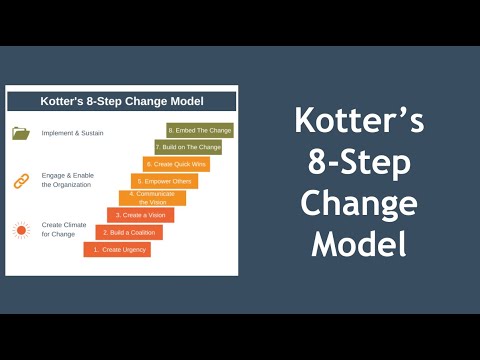
Kotter's 8-Step Change Model Explained
EPM
Clean, well-paced business-school-style walkthrough of all eight steps with practical examples; the best single primer if you have never seen the model.

Leading Change by John P. Kotter. 8-step Change Model: Animated Summary
BigIdeasGrowingMinds
Animated summary of the original book — good for locking the sequence into memory fast.

Kotter's 8 Step Change Model
Accounting Professor.org- Ben Wann
More applied and business-context-heavy than most explainers, with attention to why transformations fail at specific steps.

Kotters 8 steps leading change
flixabout.com
Short and visual; a useful two-minute refresher the night before a case round.
Go deeper
The 8-Step Process for Leading Change
Kotter Inc. (official)
The primary source. Kotter's own current wording for each step, including the updated names like 'Enlist a Volunteer Army' and 'Enable Action by Removing Barriers'.
8 Steps to Accelerate Change in Your Organization (free eBook)
Kotter Inc.
Free full-length PDF from Kotter's firm covering the accelerators framing and the dual operating system — the depth most students never read.
Kotter's 8-Step Change Model
Mind Tools
The most practical step-by-step explainer, with concrete actions and questions to ask at each stage — good for turning the model into case-ready talking points.
Kotter's eight-step change model
The Open University (OpenLearn)
Free university-level treatment with a diagram and an applied exercise, set inside a broader change-management course you can read for context.
Kotter's Change Management Theory: Explanation and Applications
Prosci
A change-management consultancy's critique comparing Kotter to ADKAR and being honest about where the model falls short — useful for the limitations you should raise unprompted in an interview.
Now use it on a real case
Reading a framework isn't the same as applying it under pressure. Practise with an AI interviewer that pushes back.
Practise a case free