5Cs Situational Analysis
Scan the whole board — Company, Customers, Competitors, Collaborators, Context — before you recommend anything.
On this page
The gist
- →5Cs = Company, Customers, Competitors, Collaborators, Context — a diagnostic scan for broad launch/marketing cases, never for narrow number cases
- →It generates questions, not answers: scope and weight the Cs for the case, start with Customers, then hand off to STP or 4Ps to decide
- →Collaborators (dealer margins, platform take rates, shelf space) is the most-skipped C and most often hides the real insight in Indian cases
- →Score comes from 2-3 cross-bucket tensions and a hypothesis, not five tidy summaries — a 5Cs with no 'so what' is a book report
The framework at a glance
When to use it
Reach for the 5Cs when the prompt is broad and diagnostic rather than a single sharp number. Classic triggers: "Our client is a consumer goods company launching a new product in India — how should they think about it?", "Client wants to enter the Indian market, what should they consider?", "A brand is losing share and does not know why", "Should we launch this in tier-2 cities?", "Client is planning next year's marketing strategy", or any brand, positioning, go-to-market or launch case. It is also the right opening when the interviewer gives you a rich, messy situation and no obvious metric — the 5Cs buys you a structured sweep instead of a guess. Do NOT reach for it when the case is explicitly quantitative and narrow: a profitability decline (use a profit tree), a pricing decision (use a pricing framework), a cost or operations problem (value chain), or a make-versus-buy. In those cases the 5Cs is too wide and you will burn four minutes describing the macro environment while the interviewer waits for you to isolate the cost line. A useful test: if the answer will eventually be a number, do not open with 5Cs. If the answer will eventually be a positioning statement or a go/no-go, do.
What it is
The 5Cs is a situational analysis framework. It does not tell you what to do. It tells you what you need to know before you are allowed to have an opinion. The five buckets are Company, Customers, Competitors, Collaborators and Context (Context is also called Climate in older marketing textbooks — same thing). Together they cover the three layers of any business situation: the inside of the firm, the micro-environment it trades in every day, and the macro-environment it cannot control. Run all five and it is very hard to miss something big.
Keep reading ↓Show less ↑
The lineage matters because it explains the shape. Kenichi Ohmae, the Japanese strategist who ran McKinsey's Tokyo office, popularised the 3Cs — Company, Customers, Competitors — as the "strategic triangle": a business wins when its capabilities meet a customer need better than rivals do. Marketing academics later added two Cs that the triangle kept losing money on. Collaborators covers everyone outside the firm whose cooperation you need to actually deliver — distributors, suppliers, channel partners, franchisees, platforms, dealers. Context covers the macro forces — regulation, economics, technology, social change — that can make a perfectly good plan illegal or irrelevant. So the 5Cs is the 3Cs plus "who else has to say yes" plus "what could change the rules".
The practical value in a case interview is that the 5Cs is the broadest diagnostic net you own, and it is deliberately non-committal. SWOT forces you to label things good or bad before you have evidence. Porter's Five Forces only tells you about industry attractiveness. PESTEL only looks outward. The 5Cs sits at a level above all of them: it is the scan you run to find where the real problem is hiding, after which you drop into a sharper tool. In practice it is the front half of a chain — 5Cs to diagnose, STP to choose who you are for, 4Ps to decide what you actually do. If you only remember one thing: the 5Cs generates questions, not answers. The answer comes from what you find inside the buckets.
How to apply it, step by step
- 1
Scope the question first, then tailor the five buckets
Never open by reciting the five Cs. Restate the objective and the decision on the table — 'so we need to decide whether to launch X, and success means Y by when' — then say which Cs you will weight heavily and which you will touch lightly. If it is a competitive share-loss case, tell the interviewer you will spend most of your time on Customers and Competitors and treat Context briefly. That single sentence signals judgement and separates you from a candidate reading a memorised list.
- 2
Start with the Customer, not the Company
Weak candidates start inside the firm because that is where the data is. Strong candidates start with demand. Ask who the customers are, how they segment (demographics, need, usage occasion, willingness to pay), what job they are hiring the product to do, how they decide, who else influences the purchase, and how price-sensitive they are. Size the segments if numbers are available. Everything downstream — what your capability is worth, who your real competitor is — depends on which customer you are talking about.
- 3
Company: separate what you have from what you can win with
List capabilities, cost position, brand equity, distribution reach, cash, talent and stated goals. Then apply the filter that matters: which of these is genuinely hard for a rival to copy? Distribution to a million kirana outlets is a moat; a good ad agency is not. Also name the constraints explicitly — a parent-company margin threshold, a cannibalisation risk, a promise to shareholders. Constraints are where recommendations go to die, and finding them early makes you look experienced.
- 4
Competitors: map both the current set and the next set
Cover direct rivals, indirect substitutes, and potential entrants — including the customer's option to do nothing. For each, get relative share, price point, positioning, cost structure and likely reaction to your move. The reaction question is the one people skip: if we cut price 15 percent, does the incumbent match within a week? Also ask who is not in the market yet but easily could be — a platform, a private label, an adjacent-category giant with the same distribution.
- 5
Collaborators: work out who else has to say yes
Distributors, retailers, suppliers, logistics partners, quick-commerce platforms, franchisees, banks, technology vendors, regulators-as-partners. For each ask three things: do we need them, do their incentives point the same way as ours, and what do they charge or demand? Most launch plans fail here — the product is fine, but the trade margin is too thin for retailers to stock it, or the platform takes a cut that kills unit economics. This is the C that most candidates skip and the one that most often contains the real insight.
- 6
Context: run a fast PESTEL screen for deal-breakers only
Political, Economic, Social, Technological, Environmental, Legal. Keep it to sixty seconds and only surface what could change the decision: a GST slab, an FDI or FSSAI rule, an import duty, a UPI or ONDC shift, a demographic trend, a monsoon or commodity cycle. Do not list eight macro trends that have no bearing on the answer. One binding constraint found here is worth more than a paragraph of general observations about India's growing middle class.
- 7
Synthesise: convert the scan into two or three insights, not five summaries
After the sweep, say out loud: 'Pulling these together, the picture is...'. Look for tensions across buckets — a customer need that no competitor serves and that your distribution uniquely reaches, or a strong capability that a regulatory change is about to devalue. That intersection is the answer. Then state a hypothesis you can test with the remaining case time. A 5Cs that ends with five neat paragraphs and no point of view scores badly.
- 8
Hand off to the next framework
The 5Cs diagnoses; something else decides. If the finding is about who to serve, move to STP (segmentation, targeting, positioning). If it is about what to do, move to the 4Ps. If it is about whether the industry is worth entering at all, move to Porter's Five Forces or a market-entry structure. Naming the handoff explicitly — 'given that, let me take the target segment through the 4Ps' — makes the interview feel like a real engagement rather than a framework recital.
Worked example
Amul (GCMMF) is considering launching a high-protein, ready-to-drink milkshake for urban Indian consumers — roughly 20g of protein per 200ml bottle, target price around Rs 70. The board wants to know whether to go ahead and, if so, on what basis. All figures below are illustrative, chosen to show how the reasoning works rather than as reported facts.
Scope and objective
Decision: launch or not, nationally. Success defined as Rs 300 crore of revenue and contribution-positive within 24 months, without cannibalising the existing Amul Kool flavoured-milk line. Given it is a launch into an existing category, I will weight Customers, Competitors and Collaborators heavily, and use Company and Context mainly to check for constraints.
Customers
Three plausible segments. First, urban gym-goers aged 22-35 who currently buy imported whey powder at a few thousand rupees per kilo — high willingness to pay, but a small pool. Second, health-conscious white-collar professionals who want protein without a scoop and a shaker — much larger, but price-sensitive above roughly Rs 60-70 and buying on convenience rather than performance. Third, parents buying for teenagers, who buy on trust and safety more than on macros. Key insight: the second segment is where the volume lives, and its job-to-be-done is 'a filling, guilt-free thing I can drink at my desk', not 'muscle gain'. That single finding changes the positioning and the price point.
Company
Amul's real assets are milk procurement at cooperative scale from millions of farmer members, a cold chain already built for fresh milk, distribution reaching over a million retail outlets, and a brand with unusually high trust on the dimension that matters here — 'is this actually pure'. Constraint: the cooperative model runs on thin margins and mass pricing, and Amul has historically been stronger at mass SKUs than premium ones. Internal expectations of contribution margin may not survive a Rs 70 price point, and cannibalisation of Amul Kool at Rs 25-30 is a real risk if we position on flavour rather than protein.
Competitors
Direct: Epigamia and similar value-added dairy players, Nestle's protein milk range, and D2C entrants like The Whole Truth. Substitutes: whey powder tubs (cheaper per gram of protein, less convenient), paneer and eggs (the cheapest protein in India by a distance), and doing nothing. Potential entrants: Reliance Consumer and ITC, both of which have comparable distribution and are actively building protein portfolios, plus private labels from quick-commerce platforms. Likely reaction: Epigamia cannot match us on price or reach and would retreat to premium; a Reliance response is the genuine threat and would probably land within two quarters. Insight: our defensible edge is milk cost and reach, not product innovation — so we should win on price-per-gram-of-protein and availability, not on novelty.
Collaborators
This is where the case turns. The product needs chilled distribution across modern trade, general trade and quick commerce. General trade retailers stock what turns fast at a decent absolute margin; on a Rs 70 SKU a standard trade margin gives them roughly Rs 6-7 a bottle, which is workable, but chilled shelf space in a kirana is scarce and already occupied by our own faster-turning products. Quick-commerce platforms reach exactly the urban professional segment we identified and will carry cold SKUs, but take a platform cut plus listing and visibility fees, which compresses contribution. Our village-level cooperative societies and chilling centres help upstream, not downstream. Conclusion: launch through quick commerce and modern trade first, where the target customer actually shops, and treat general trade as phase two.
Context
Only three things matter here. FSSAI rules on protein claims and front-of-pack labelling determine what we can legally print on the bottle. GST treatment of flavoured and value-added milk beverages differs from plain milk and feeds straight into the shelf price we can hit. And the social trend — rising protein awareness in urban India, amplified by fitness content and a visible gap between recommended and actual protein intake — is the reason the category is growing at all. Monsoon and FDI policy are noise for this decision and I will not spend time on them.
Synthesis and recommendation
The intersection: a large, under-served mainstream segment wants convenient protein at a mass price; Amul is close to the only player with both the milk cost base and the trust to deliver protein cheaply at scale; the binding constraint is not demand or capability but channel economics and chilled shelf space. So yes, launch — but position on 'affordable everyday protein' for the professional segment rather than on sports performance, price at Rs 60-65 to stay under the psychological threshold and make the price-per-gram-of-protein story unbeatable, go to market through quick commerce and modern trade in the top eight cities first, and differentiate the pack sharply from Amul Kool to limit cannibalisation. Next step: run that target segment through STP and then the 4Ps.
Takeaway: The 5Cs did not produce the answer by itself — it produced the collision that produced the answer. Customers said the mainstream segment is price-sensitive, Company said Amul's edge is cost and trust rather than innovation, and Collaborators said the real bottleneck is channel margin and shelf space. Those three facts together forced a mass-price, quick-commerce-first launch. Any one bucket read alone would have given a different and worse recommendation.
More worked examples
Worked example: Peloton in early 2022 — what the 5Cs said before the pivot+
It is February 2022. Peloton has just replaced its founder-CEO, announced roughly 2,800 job cuts and cancelled a planned US factory. Demand that quadrupled during lockdowns has flattened, the flagship Bike has already been price-cut, and the company is burning cash. The board's question is deliberately broad: what business are we actually in, and what should we do next? All figures below are approximate and publicly reported, used to show the reasoning rather than as audited fact.
FY2021 revenue
~$4.0B (approx)
Connected-fitness subs
~2.8M (approx)
Subscription gross margin
~65-70% (approx)
Bike list price
$1,895 to $1,495 (2021)
Illustrative subscriber LTV
~$1,050
Scope and objective
Restate the decision before touching the buckets: this is not "is connected fitness attractive" — the market already answered that. It is "our demand assumption broke; which parts of this business are worth keeping and how do we fund them". I will define success as reaching free-cash-flow positive within about 18 months while keeping monthly subscriber churn under 1 percent. Given that, I will weight Context heavily (I need to know if the demand fall is a dip or a level shift), Customers heavily (which buyers actually stay), and Collaborators heavily (that is where cost structure can be changed fastest). I will treat Competitors lightly, because the thing taking Peloton's demand is not a rival treadmill, it is gyms reopening.
Customers
Segment by why they bought, not by demographics. Segment one, pandemic-substitution buyers who bought because their gym shut — these are the churn risk and they were never really Peloton customers. Segment two, committed enthusiasts riding three-plus times a week whose observed churn ran under roughly 1 percent a month; at that rate average subscriber life is 40-plus months. Segment three, aspirational buyers who want it but stall at $1,495 upfront plus $39 a month. Do the arithmetic on segment two: 2.8 million subscribers at $39 a month is roughly $1.3 billion of annual subscription revenue at a 65-70 percent gross margin, and per-subscriber lifetime gross profit is roughly $39 x 0.68 x 40, or about $1,050 — and that money arrives whether or not another bike ever ships. The job-to-be-done for the core segment is "a scheduled, coached workout with accountability, at home", and that job is delivered by the content and the leaderboard, not by the steel frame.
Company
Split the assets into copyable and non-copyable. Non-copyable: the instructor roster and the content library — that is a talent and production business a competitor cannot clone with engineers — plus the community and the subscription base itself. Copyable and expensive: owned manufacturing (the Tonic acquisition), the Precor commercial business, a fleet of leased showrooms, an in-house delivery and installation operation, and a very large inventory position. The cost structure tells the story: subscription gross margin is roughly 65-70 percent while hardware gross margin collapsed toward zero once the Bike was cut to about $1,495 and air-freight costs spiked, meaning each incremental bike was close to cash-neutral. Binding constraints: inventory-funded cash burn running into the high hundreds of millions per year, and the Tread+ recall, which specifically raises the cost and risk of being a hardware manufacturer.
Competitors
Direct: Apple Fitness+ at roughly $9.99 a month, iFIT/NordicTrack, Tonal, Lululemon's Mirror, Hydrow. Indirect, and far more important: reopened gyms at roughly $10-40 a month, plus free running and YouTube — the "do nothing new" option, which is what most churning subscribers actually switched to. Reaction test: Apple prices Fitness+ as an ecosystem loss-leader, so any strategy that competes on subscription price is unwinnable; the defensible axis is instructor-led programming and community depth, which is exactly the non-copyable asset. One counter-intuitive competitor: Peloton's own installed base — used Bikes were reselling on Facebook Marketplace at roughly $400-800, undercutting the new unit. But the used buyer still has to pay $39 a month to use it, which reframes the secondary market from a threat into an unpaid acquisition channel.
Collaborators
Peloton had almost none — that is the finding. It manufactured its own hardware, sold direct only, ran its own mall showrooms, and delivered and installed with its own vans and warehouses, capturing full margin on a product that now earned no margin, while carrying the entire fixed cost. The available collaborators are third-party retail (Amazon, DICK'S Sporting Goods), contract manufacturers such as Rexon in Taiwan, and third-party logistics. The trade-off is explicit: giving a retailer 10-20 points on hardware costs almost nothing when hardware gross margin is already near zero, and in exchange fixed showroom and delivery cost becomes variable, and the bike appears in front of shoppers who would never walk into a mall showroom. A rental or hardware-as-a-service offer at roughly $89-149 a month does the same job on the demand side, converting a $1,495 barrier into a monthly line item for segment three.
Context
Vaccination and gym reopening removed the demand driver, and the honest read is that this is a permanent level shift, not a dip — so every plan calibrated to FY2021 run-rates is void, and capacity built for that run-rate is stranded. Rising interest rates repriced growth equity, which meant "grow now, fund later" stopped being available and free cash flow became the scoreboard, not subscriber adds. Freight and component costs spiked at exactly the moment pricing power evaporated, squeezing landed hardware cost from both ends. And the CPSC Tread+ recall is a regulatory fact that raises the specific cost of being a hardware owner-operator, reinforcing the same direction as the economics.
Synthesis and recommendation
The buckets collide into one conclusion: Customers say the real asset is a sub-1-percent-churn subscription worth roughly $1,050 in lifetime gross profit; Company says the only non-copyable things are content and community; Collaborators say manufacturing, retail and delivery can all be rented from someone with better scale; Context says cash, not growth, is now the score. So stop treating hardware as a profit line and start treating it as customer acquisition with a spend ceiling set by LTV — a bike sold at break-even that yields a $1,050 subscriber is a good trade, and a bike that never sells because of a $1,495 wall is a lost one. Concretely: exit owned manufacturing and shrink showrooms and self-delivery; distribute through Amazon and DICK'S; launch rental and certified-refurbished tiers to monetise the price-sensitive and used-market buyers; protect content and instructor spend because that is the moat; hold subscription price rather than discounting into Apple's floor. Note that a hardware-only lens says "cut prices harder" and a subscription-only lens says "raise prices" — only the full scan produces "change the channel".
Takeaway: The 5Cs relocated the problem. The symptom appeared in Company (cash burn on hardware), so the instinctive fixes were price cuts and layoffs. But Customers proved the subscription annuity was intact and worth about $1,050 per head, which turned hardware into an acquisition cost rather than a product; Collaborators then showed that acquisition cost could be slashed by renting other people's factories, shelves and vans. The lever was never in the bucket where the pain showed up.
Worked example: an Indian two-wheeler major deciding how to go electric in tier-2 India+
Your client is one of India's top-three two-wheeler manufacturers, with roughly 15-18 percent of the domestic scooter market and about 2,500 sales-and-service touchpoints, almost all built around petrol vehicles. Electric two-wheelers are now roughly 6 percent of the market and growing fast, but the client's e-scooter is selling under 4,000 units a month, mostly in metros, while a digital-first rival outsells it three to one. The CEO asks: how do we win in electric over the next three years, specifically in tier-2 and tier-3 India where our network is strongest? All figures are illustrative and rounded, chosen to show the reasoning.
Domestic 2W market
~18M units/yr (approx)
E-2W penetration
~6% of 2W (approx)
Running-cost gap
~Rs 2.0/km (illustrative)
Payback on price premium
~12-13 months (illustrative)
Dealer service annuity at risk
~Rs 3,500/vehicle/yr (illustrative)
Scope and objective
First narrow the question: the client is not asking whether EVs will happen, the market has settled that — they are asking with what product, at what price, through which channel, and in which geography. I will define success as 10 percent share of the e-2W market within three years, with two guardrails: average dealer profitability per outlet must not fall below today's level, and blended contribution margin must not dilute by more than a stated number of points. Given that framing I will weight Customers (because tier-2 usage economics decide whether an EV is even rational), Collaborators (because the client's asset is a dealer network) and Context (because subsidies and GST decide the price) heavily. Competitors I will cover quickly, and I will flag up front that the incumbent to beat is the client's own petrol scooter.
Customers
Segment by kilometres per day, not by age or income, because payback is a linear function of distance. Segment A, the tier-2 daily commuter riding 25-40 km a day, roughly 900-1,200 km a month. Segment B, the household second vehicle doing 8-10 km a day. Segment C, gig delivery riders at 80-120 km a day. Segment D, semi-urban and rural buyers with unreliable grid supply and long single trips. Now the economics: petrol at about Rs 105 a litre and 45 km per litre is roughly Rs 2.3 per km, while an e-scooter using about 3 kWh per 100 km at Rs 8 a unit is roughly Rs 0.25 per km — a gap of about Rs 2 per km, or roughly Rs 2,000 a month for Segment A, against an on-road price premium of about Rs 25,000, so payback lands near 12-13 months and drops toward 11 once you add Rs 2,000-3,000 of annual service saving. For Segment B that same premium takes four years to repay, so EV is simply the wrong product for them today, and Segment C has the best maths but lives in metros and needs swapping plus financing. Also note the decision rule: these buyers compare monthly outflow, EMI plus fuel, not sticker price — and the person who frames that comparison is the dealer salesman, not an ad.
Company
Non-copyable assets: about 2,500 sales-and-service touchpoints in towns of two to ten lakh population, where the digital-first rivals have almost no service presence and where a buyer's real fear is "who fixes it here when it breaks"; a brand the buyer's father trusts; tied NBFC relationships that can move an EMI; and purchasing scale on the non-cell bill of materials. Genuine gaps: no cell chemistry or cell manufacturing, and cells are roughly 35-40 percent of the BOM and largely imported; weak software, OTA and app capability; and no muscle in digital-first considered-purchase selling. The binding constraint is internal and unstated until you dig for it — a petrol scooter today earns a healthy contribution per unit while the e-scooter at launch earns much less, so every EV sold to an existing petrol buyer is margin-negative in year one, and the CFO's plan quietly depends on that not happening at scale. Filter test: the moat is the small-town service footprint, not the vehicle design or the app, both of which a rival can match within a product cycle.
Competitors
Direct: Ola Electric, online-first and price-aggressive with a weak service reputation; Ather, premium at roughly Rs 1.4-1.5 lakh with a strong product and its own charging network but metro-skewed; TVS iQube and Bajaj Chetak, which run exactly the client's dealer-led playbook and are therefore the real fight; Hero's Vida; and Honda's electric entry, which brings Activa-level brand equity into the segment. Substitutes: the client's own petrol scooter, which is the single largest competitor in the room, plus used scooters and shared autos. Potential entrants: low-speed sub-25-kmph e-scooters at Rs 60,000-70,000 that need no registration, licence or subsidy and land squarely in the tier-3 price band, and battery-swapping networks that change ownership from buying a vehicle to renting energy. Reaction test: TVS and Bajaj can match any price move within a quarter because their cost base mirrors the client's, so price is not defensible; the digital-first players cannot follow the client into 2,500 service points in three years, so service confidence and uptime are.
Collaborators
This is where the case turns. A typical two-wheeler dealer earns only about 3-4 percent on the vehicle itself, roughly Rs 3,000 on a Rs 90,000 scooter, and makes the rest of his gross profit from service labour, spares, insurance and finance commissions — service and spares are commonly 35-50 percent of dealer gross profit. An electric scooter deletes engine oil, air filter, spark plug, clutch and most periodic labour: scheduled visits fall from about three or four a year at Rs 1,000-1,500 each to one or two at around Rs 400, destroying roughly Rs 3,000-4,000 of annuity per vehicle per year. So the dealer's rational move, standing in front of an undecided walk-in, is to steer him to the petrol model — and he will, because he owns the conversation and the test ride. Two other collaborators matter: cell suppliers, where import dependence creates forex and geopolitical exposure on 35-40 percent of cost, and NBFC financiers, who currently assume weak EV resale value and therefore quote higher rates or lower loan-to-value, which lands directly on the monthly outflow the customer is comparing.
Context
Demand-side subsidies of the FAME-II and PM E-DRIVE type are declining and time-bound, so any plan whose unit economics need the subsidy has an expiry date printed on it — the product must clear its payback test at close to zero subsidy by year two. The structurally durable lever is GST: 5 percent on EVs against 28 percent plus cess on ICE, a wedge of roughly 20 points that is policy-stable and is the real affordability engine. State EV policies differ on road tax and registration waivers, swinging on-road price by Rs 5,000-10,000 between cities, which makes city selection partly a policy arbitrage rather than just a demand exercise. Battery safety norms tightened after the 2022 fire incidents, raising compliance cost in a way that actually favours incumbents with testing infrastructure, and localisation and PLI rules shape whether cells are imported, assembled or eventually made in-house.
Synthesis and recommendation
The collision: Customers say only the 25-40 km-a-day commuter has a payback under about 18 months; Company says the only durable moat is the small-town service network; Collaborators say that very network is financially incentivised to kill the product at the point of sale; Context says the durable price advantage comes from the GST wedge rather than a subsidy that will lapse. So the recommendation is to target Segment A in the 30-40 tier-2 cities where state policy also waives road tax; price to a twelve-month payback assuming zero subsidy, funded by the GST differential rather than by discounting; and, before launch, rebuild dealer compensation — raise front-end vehicle margin to roughly 6-7 percent and add an annual battery-health and connected-diagnostics package plus a warranty service fee, so per-vehicle annuity is broadly restored. Alongside that: partner rather than build on cells for three years while watching localisation policy, and co-create a finance product with an NBFC backed by a manufacturer residual-value guarantee to cut the EMI. Finally, deliberately keep the petrol scooter positioned at the low-kilometre second-vehicle buyer, so cannibalisation lands exactly where EV payback is bad anyway. Next tools: pricing to set the ladder, then the 4Ps for the launch plan.
Takeaway: Everyone in the room walked in assuming the EV question was a product and technology question — range, battery, app, design. The 5Cs showed that the binding constraint sits in Collaborators (the dealer loses about Rs 3,500 a year of service annuity per EV sold, so he sells against you) and the binding economics sit in Context (GST, not the expiring subsidy). Fix the dealer P&L and a good-enough product will sell; ship a brilliant product into a hostile dealer network and it will do 300 units a month in a market of 18 million.
Common pitfalls
- •Reciting the five Cs as a checklist and giving each equal airtime. Interviewers can hear a memorised list within ten seconds. The Cs are never equally important in a given case — say which two matter most for this problem and why, then go deep there.
- •Producing five tidy descriptions and no point of view. A situational analysis that ends without a 'so what' is a book report. The score comes from the insight that sits across two or three buckets, not from the completeness of the buckets.
- •Skipping Collaborators because it feels vague. It is usually the highest-yield C in Indian consumer and retail cases, where distributor margins, kirana shelf space, quick-commerce take rates and franchisee economics decide whether a good product ever reaches anyone.
- •Turning Context into a five-minute macro essay. India's demographics, digital adoption and rising middle class are true, generic and worth nothing in a case unless one of them binds the specific decision. Name only what changes the answer.
- •Using 5Cs on a case that wanted arithmetic. Profitability, pricing and cost cases need a driver tree, not a scan. Opening with 5Cs on a 'profits are down 20 percent' prompt reads as framework-dumping and burns the clock before you touch the numbers.
- •Confusing Competitors with Collaborators, or Context with Company. Suppliers who supply you are collaborators; suppliers who could forward-integrate and eat your margin belong in competitors too. If something fits two buckets, say so explicitly rather than silently dropping it.
Interview tips
- •Open by scoping and weighting, not by listing. 'I want to look at the customer and the competitive set first, then check company capability and channel economics, and finish with any regulatory constraints' beats 'I will use the 5C framework' every time.
- •Reorder the Cs to fit the case. Customer-first is the default for launch and marketing cases; Company-first works when the client has a clear stated capability or constraint; Context-first is right when a regulatory or technology change triggered the case in the first place.
- •Ask for data inside each bucket instead of narrating. The 5Cs is a question generator. 'Do we know how the customer base splits by usage occasion?' is a better use of thirty seconds than a paragraph of assumptions about Indian consumers.
- •Do not skip Collaborators. It is the least-practised C and therefore the easiest place to sound differentiated. Trade margin, platform take rate, distributor incentives and franchisee economics are where launch plans actually break.
- •Keep Context to about sixty seconds and only mention what binds the decision. One GST slab or FSSAI labelling rule that moves your price point is worth more than five general macro trends.
- •Always close the loop. After the sweep, state two or three cross-bucket insights plus a hypothesis, then name the next framework — STP or the 4Ps — so the interviewer sees you treat 5Cs as a diagnosis, not a recommendation.
Test yourself
Best video explainers
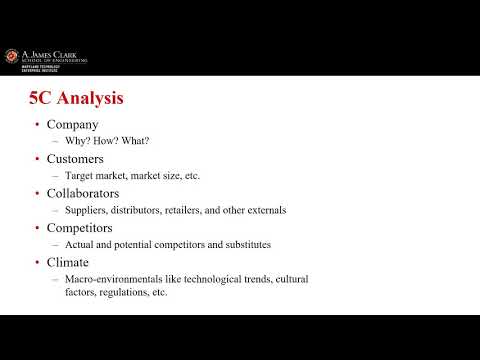
5C Analysis
Entrepreneur Essentials by University of Maryland
Short, university-taught explainer that defines each C cleanly — the most authoritative starting point if you have never seen the framework.

The 5C's of Marketing I हिंदी I Situational Analysis for Business Part 1 I Dr Vijay Prakash Anand
Marketing by Vijay
An Indian marketing professor walking through the framework in Hindi with India-based examples — closest to how it comes up in an Indian MBA classroom.

5Cs of Marketing Part 2 by Dr Vijay Prakash Anand
Marketing by Vijay
The second half of the same series, covering the remaining Cs and how the buckets connect into an actual strategy.

The 5 Cs of Marketing Strategy!
Realist Academy
A compact overview framing the 5Cs specifically as situational analysis feeding into a marketing plan — good revision the night before an interview.
Go deeper
5C Analysis — Marketing
Corporate Finance Institute
Clean, business-school-grade definition of each C, with a useful emphasis on identifying sustainable competitive advantage under Company.
What is the 5C Analysis? Overview, Definition and Examples
Peak Frameworks
Written for finance and consulting recruiting, with a worked example per C and an explicit link from Climate down to PESTEL.
Situation Analysis
Wikipedia
Traces the 5Cs back to Ohmae's 3C strategic triangle and situates it among the 4Ps, SWOT and PESTEL — useful for understanding why the framework has the shape it does.
How to Conduct a 5C Analysis: Process, Questions, Examples
Product Marketing Alliance
The most practical of the set — gives you the actual list of questions to ask inside each bucket, which is exactly what you need live in a case.
Marketing Case Interview: 5C-STP-4P Framework and Drills
RoadToOffer
Shows how the 5Cs chains into STP and then the 4Ps across a full marketing case, with drills — the interview-specific application.
Now use it on a real case
Reading a framework isn't the same as applying it under pressure. Practise with an AI interviewer that pushes back.
Practise a case free