PESTEL Analysis
Six buckets for scanning the outside world — then the discipline to throw away the four that don't change the decision.
On this page
The gist
- →PESTEL scans the macro ring outside the industry: Political, Economic, Social, Tech, Environmental, Legal forces the client cannot control.
- →Sweep all six in 30 seconds, then cut hard: keep the 2-3 factors that move the decision and say out loud why you dropped the rest.
- →Turn every survivor into a directional claim with a number (a 25 percent price cut, 9 months of delay) — nouns like regulation are not analysis.
- →Separate structural forces (change whether to enter) from timing forces (change when and how), and close with a decision, one killer risk, a mitigation.
The framework at a glance
When to use it
Reach for PESTEL when the question is about a world your client does not yet operate in, or a world that is about to change underneath them. The classic triggers: entering a new country or state ("should we launch in Indonesia?"), entering a heavily regulated sector (banking, insurance, pharma, telecom, defence, mining, alcohol, education), evaluating an industry facing a policy inflection (EV transition, coal phase-down, drone rules, data localisation), sizing a long-horizon investment where five-year macro assumptions dominate the NPV (a plant, a licence, a port), an ESG or sustainability mandate, or a case that opens with an external shock ("our client's margins collapsed after the government did X"). It is also the right opening move when a prompt is deliberately vague about industry structure and the interviewer wants to see whether you can map an unfamiliar landscape. Do not reach for it when the question is internal and diagnostic — a profitability drop, a cost overrun, an operations bottleneck, a pricing decision inside an existing market. There PESTEL is a detour, and interviewers read it as framework-dumping. And never use it alone: PESTEL tells you what the weather is, not whether you should be the one flying the plane. Pair it with Porter's Five Forces for industry attractiveness, a market-entry structure for the go/no-go, and a SWOT if you need to fold it back into the client's own position.
What it is
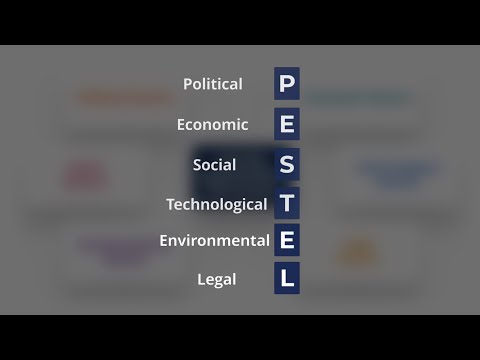
PESTEL is a checklist for the world outside the company. It splits the macro-environment into six buckets — Political, Economic, Social, Technological, Environmental, Legal — and asks, for each one, what forces are at work that the client cannot control but must plan around. The point is not the acronym. The point is that human beings systematically forget entire categories of risk. Left to intuition, most people analysing an Indian market entry will talk about demand and competition and completely miss that a state government is about to change its subsidy policy, or that a new battery safety norm adds eighteen months to certification. PESTEL exists to make you forget nothing.
Keep reading ↓Show less ↑
It sits at the outermost ring of strategy analysis. Think of three concentric circles: the company (its costs, capabilities, people), the industry (customers, competitors, suppliers, substitutes), and the macro-environment (everything above the industry that affects every player in it). Porter's Five Forces covers the middle ring. PESTEL covers the outer ring. A useful test: if a factor hits your client and every competitor roughly equally, it is PESTEL. If it hits your client differently from a rival, it is probably competitive analysis or an internal capability question. Inflation, GST rates, monsoon patterns, data protection law — PESTEL. Supplier concentration, switching costs, a rival's distribution reach — Five Forces.
The framework was popularised out of Harvard Business School in the 1960s as simple PEST (Francis Aguilar's environmental scanning work) and grew two more letters as environmental and legal issues became strategic rather than administrative. That history matters for one reason: the letters are a checklist, not a structure. Nobody wins a case by producing a tidy six-box grid. You win by sweeping all six in thirty seconds, finding the two or three that genuinely change the answer, quantifying them, and dropping the rest out loud so the interviewer knows you considered and rejected them. The scan is broad; the output is narrow. Analysts who cannot do the narrowing produce a wall of true-but-useless statements, which is the single most common way this framework fails in the room.
How to apply it, step by step
- 1
Anchor on the decision before you touch the acronym
Write the actual question at the top of your page: 'Should Client X invest Rs 3,000 crore in an Indian EV plant by 2028?' Every factor you later list has to earn its place by moving that decision. If you cannot say which way a factor pushes the answer, it does not go on the page. This one habit is the difference between a PESTEL that scores well and one that reads as a Wikipedia dump.
- 2
Set the boundary: geography, industry, time horizon
PESTEL is meaningless without scope. 'India' is not a boundary — EV policy in Delhi, Maharashtra and Uttar Pradesh differ materially, and a two-wheeler analysis is not a four-wheeler analysis. State your three boundaries out loud: which market, which segment, over what horizon. A three-year horizon and a ten-year horizon produce completely different Technological and Environmental answers, and interviewers notice when you skip this.
- 3
Sweep all six letters fast, then cut hard
Spend about thirty seconds generating raw factors across all six buckets — this is the part that stops you missing a category. Then immediately cut. Say something like: 'I generated across all six; Social and Environmental don't move this decision much because the product is B2B and low-emission already, so I'll focus on Political, Legal and Technological.' The cut is the skill. Naming what you dropped and why is what separates you from someone reciting.
- 4
Turn every factor into a directional claim, not a noun
'Regulation' is a noun and tells the interviewer nothing. 'The FDI cap in multi-brand retail forces us into a franchise structure, which cuts our gross margin by roughly a third' is a claim. Every line should have a subject, a direction (helps or hurts), and ideally a rough magnitude. If you write only nouns, you have produced a topic list, not an analysis.
- 5
Score impact against likelihood and keep the top three to five
Mentally plot each surviving factor on two axes: how big is the effect if it happens, and how likely is it in your time horizon. High-impact and high-likelihood factors become the spine of your answer. High-impact but low-likelihood factors become your risk section and your sensitivity case. Low-impact factors get named once and abandoned. Doing this out loud gives the interviewer a clean view of your prioritisation logic.
- 6
Force each surviving factor into a number
This is where most candidates stop too early. A subsidy is not 'positive' — it is Rs 10,000 per kWh on a 3 kWh battery, so roughly Rs 30,000 off a Rs 1.2 lakh scooter, which is a 25 percent effective price cut. A licensing delay is not 'a risk' — it is nine months of fixed costs before first revenue. Once a factor has a number it can enter the business case; until then it is commentary.
- 7
Separate structural forces from timing forces
Some macro factors are permanent features of the market (demographics, geography, the legal system) and should change whether you enter at all. Others are timing factors (a subsidy window, an election cycle, a commodity price spike) and should only change when and how you enter. Confusing the two produces bad recommendations — candidates routinely reject a structurally attractive market because of a temporary headwind, or enter a structurally bad one because of a subsidy that expires in two years.
- 8
Close with a decision, the one killer risk, and a mitigation
End the way a partner would: 'Enter, but as a joint venture rather than a wholly-owned subsidiary, because the binding constraint is Legal — battery certification and local content rules — and a local partner cuts that from eighteen months to six. The risk that kills this is subsidy withdrawal after 2027; we should stress-test the case at zero subsidy before committing capex.' A PESTEL that does not end in a decision has not been used, only performed.
Worked example
Kenshu Motors, a mid-sized Japanese two-wheeler manufacturer, currently exports petrol motorcycles into India through a distributor. The India MD is weighing roughly USD 400 million to build a local plant and launch electric scooters from 2028, versus staying an importer. She asks: is the macro environment on our side, and if we go, how should we go? You have five minutes of structure before the numbers arrive.
Frame and bound the question
The decision is a capex commitment, not a product launch, so the horizon is roughly ten years and structural factors outrank timing factors. Boundary: India, electric two-wheelers (not cars, not commercial three-wheelers), 2026 to 2035. I will sweep all six letters, then keep the ones that move a ten-year capex decision.
Political
Central government has backed EV adoption through successive schemes — FAME I and II, then the PM E-DRIVE scheme announced in 2024 — plus a Production Linked Incentive for advanced chemistry cells that rewards local battery manufacturing. State EV policies (Delhi, Maharashtra, Tamil Nadu, Gujarat) stack additional purchase incentives and road-tax waivers on top. Direction: strongly positive on demand and on plant economics. Magnitude: subsidies have historically been worth a double-digit percentage of the retail price. Risk: this is the single most volatile input in the case — FAME II demand incentives were cut sharply mid-scheme in 2023, which proves the government will move the goalposts.
Economic
India is one of the fastest-growing large economies with a rising middle-income cohort, and two-wheelers are the mass mobility default rather than a discretionary purchase. Total cost of ownership favours EVs heavily because the running cost per kilometre on electricity is a fraction of petrol, and Indian riders are extremely fuel-price sensitive. Against that: the upfront price gap is real, most purchases are financed, and interest rates plus limited EV resale value make lenders cautious. Direction: positive on volume, negative on upfront affordability. This is where you would ask for the financing penetration number.
Social
Young median age, rapid urbanisation, and the growth of gig delivery work (food and quick commerce riders doing high daily kilometres) create a customer segment for whom EV economics are unambiguously better. Brand trust matters enormously in Indian two-wheelers and Kenshu already has decades of petrol brand equity to transfer. Counterweight: range anxiety and battery fire incidents from 2022 damaged category trust. Direction: mildly positive, and mostly a marketing problem rather than a capex problem — a candidate flag for cutting.
Technological
Cell manufacturing is the crux. India assembles packs but the cells themselves are still overwhelmingly imported, largely from China, so Kenshu's cost base is exposed to a supply chain it does not control and to trade friction it cannot predict. Public charging is thin, though the two-wheeler segment partly sidesteps this through home charging and swappable batteries. Chemistry is moving fast enough that a plant designed around one cell format could be technically stranded. Direction: this is the biggest genuine uncertainty and it belongs in the recommendation.
Environmental and Legal
Environmental: urban air quality pressure in Indian metros makes long-term policy support for EVs highly likely regardless of which party governs, which materially de-risks the Political bucket. Extended producer responsibility for battery waste adds an end-of-life cost. Legal: AIS-156 battery safety norms were tightened after the 2022 fires and certification is slow; local content rules attached to incentive schemes mean the subsidies are conditional on the plant, not just on the sale; GST treatment currently favours EVs over petrol two-wheelers by a wide margin. Direction: Legal is a timeline risk, not a go/no-go risk.
Prioritise — what actually moves the answer
Scoring impact against likelihood: Political subsidy volatility (high impact, high likelihood), Technological cell supply dependence (high impact, high likelihood), and Legal certification and local content timing (medium impact, near-certain) survive. Economic tailwinds are real but they favour every player equally and therefore do not decide whether Kenshu specifically should build. Social is a launch-marketing issue. Environmental mostly reinforces Political rather than acting independently. I am dropping Social and Environmental as standalone drivers and saying so.
Recommendation
Enter, but structure the entry around the two surviving risks. Build the vehicle assembly plant to capture local content incentives, but do not vertically integrate into cells on day one — partner or contract for cells until chemistry stabilises, accepting a slightly worse margin for a much cheaper exit. Build the base business case at zero subsidy: if the plant only clears its hurdle rate with PM E-DRIVE money intact, the project is a policy bet, not a strategy. Start certification work twelve to eighteen months before launch. The metric to watch before committing capex is landed cell cost per kWh; the trigger to reconsider is a change in import duty or local content thresholds.
Takeaway: The PESTEL sweep produced roughly eighteen true statements. Three of them decided the answer. The value of the framework was making sure the cell-supply and certification risks were found at all — intuition would have stopped at 'India loves two-wheelers and the government likes EVs' — and the value of the candidate was knowing which fifteen to throw away.
More worked examples
Worked example: ByteDance and the US divest-or-ban law on TikTok (decision point, January 2025)+
It is early January 2025. The Protecting Americans from Foreign Adversary Controlled Applications Act, signed in April 2024, gave ByteDance 270 days to divest TikTok's US operations to a non-adversary owner or have app stores and hosting providers cut it off. The deadline is 19 January 2025 and the Supreme Court is about to rule on the company's First Amendment challenge. ByteDance's board has three options on the table: divest the US business, fight and hope enforcement collapses, or walk away from the US market. You are advising them and you have five minutes of structure before you touch valuation.
US monthly users (company-stated)
~170 million
Statutory divest window
270 days (deadline 19 Jan 2025)
Est. US ad revenue (illustrative)
~USD 10 bn / year
"Project Texas" data-firewall spend (reported)
~USD 1.5 bn
Statutory penalty on distributors
~USD 5,000 per US user
Frame and bound the question
The decision is not "is TikTok a good business" — it obviously is. The decision is "which ownership structure for the US entity maximises ByteDance's risk-adjusted value, and by when." Boundary: the United States only (Europe, Southeast Asia and Brazil are separate regulatory regimes and stay out of scope), the short-form video advertising business, and a horizon of roughly twelve months because the statute imposes a hard date. That short horizon is decisive: it means timing factors outrank structural ones here, which is the exact opposite of a ten-year capex case, and it means Social and Environmental are almost certainly noise. I will sweep all six letters anyway so I do not miss a category, then cut fast.
Political — the driver, and it is bipartisan
This is not a normal regulatory dispute; it is US-China strategic competition landing on one company. The tell is that the law passed with large majorities in both chambers and was signed by a Democratic president, then enforcement discretion passed to a Republican one — meaning an election outcome changes the tempo but not the direction. Two more political facts matter: China's own export-control rules cover recommendation-algorithm technology, so Beijing has a veto on what can actually be sold, and India's outright ban of TikTok in June 2020 cost the company its single largest user base overnight, which is direct evidence that governments will absorb the consumer backlash. Direction: severely negative, high likelihood, and it is the force every other bucket is downstream of. A candidate who lists "government regulation" here and moves on has missed that the real constraint is a two-government constraint — Washington must approve the buyer and Beijing must approve the asset.
Legal — this is a deadline, not a debate
Turn the statute into mechanics rather than describing it. The law does not ban TikTok directly; it makes it unlawful for Apple, Google, Oracle and CDNs to distribute or host the app, with penalties scaled per user — at roughly USD 5,000 per user against a stated ~170 million users, the theoretical exposure is far beyond what any distributor will risk for one app. So compliance is guaranteed the moment the deadline passes, whatever ByteDance does. The statutory safe harbour is a "qualified divestiture": ByteDance must fall below a 20 percent ownership threshold and there must be no operational relationship on the algorithm or data sharing. Second-order legal exposure runs alongside — Irish DPC fines running into the hundreds of millions of euros over child data and China data transfers, plus a wave of US state age-verification and youth-safety laws. Direction: Legal converts an open-ended political fight into a dated, binary event, which is why it moves from "risk section" to "spine of the answer."
Economic — size the thing you would be giving up
Estimates put TikTok's US advertising revenue around USD 10 billion a year against ByteDance group revenue in the low hundreds of billions — so the US is a modest revenue share but a hugely disproportionate share of enterprise value, because the US is the highest-ARPU ad market on earth and sets the global valuation multiple. Ad spend itself is cyclical and was recovering through 2024, so the sale would be into a decent, not distressed, market. The buyer pool, however, is the binding economic constraint: at any credible valuation for the US business, only Big Tech (blocked on antitrust grounds), sovereign funds, or a consortium of private capital can write the cheque, and a consortium takes months to assemble. Note the sunk cost honestly — roughly USD 1.5 billion already spent on the Project Texas data firewall bought regulatory goodwill that the statute then ignored, which tells you technical remedies do not solve political problems.
Social and Technological — one matters, one does not
Social first, so I can drop it: TikTok's US user base is young, huge and vocal, and the brief shutdown showed real migration risk to Reels and Shorts, but public sentiment has already been tested against this law and lost. It affects how painful a shutdown would be, not whether the law bites — so it is a communications issue, not a decision driver, and I am setting it aside. Technological is the opposite and is the second true crux: the recommendation engine, not the user base, is the asset, and it is trained and maintained in China. A qualified divestiture that satisfies the "no operational relationship" test implies handing over or re-licensing and retraining the model on US infrastructure — technically feasible but slow, and it risks degrading the feed quality that is the entire product. Environmental I generate and drop in one line: data centre energy use is a real cost input but does not move an ownership decision on this timeline.
Prioritise on impact times likelihood
Three factors survive. Political direction (high impact, near-certain) sets the outcome. Legal deadline mechanics (high impact, certain) set the clock and the structure of any deal — specifically the sub-20 percent threshold and the no-operational-relationship test. Technological algorithm transferability (high impact, uncertain) determines whether a compliant deal produces a product anyone still wants. Economic buyer-pool depth is a medium-impact enabler. Social and Environmental are named and dropped. Notice what the scoring exposes: the two factors that decide the answer sit in the two buckets most candidates rush through fastest, because they read "Political" as "stability" and "Legal" as "compliance" instead of as a countdown clock with a defined safe harbour.
Recommendation
Negotiate a structured divestiture now rather than litigating to the wire. Concretely: a US joint venture in which ByteDance holds under the 20 percent statutory ceiling, US investors and a trusted cloud partner hold the majority and control the data plane, and the algorithm is licensed and retrained on US infrastructure under third-party oversight so the "no operational relationship" test is met on paper and in practice. Use the litigation and any enforcement-delay window as negotiating time, not as a strategy — the base case must assume the law is enforced. The killer risk is Beijing blocking the algorithm transfer under its export rules, so run a parallel workstream on a US-trained model and be willing to accept measurably worse recommendation quality for two to three quarters. The trigger to walk away entirely is a Chinese export licence denial, not a bad price.
Takeaway: The scan produced perhaps twenty true statements about TikTok's environment; three decided the answer, and two of them (Political and Legal) were in buckets that a fast candidate treats as boilerplate. The framework's real output here was a reframe: this was never a valuation question, it was a question of which structure clears two governments and one export-control regime by a fixed date. What actually emerged through 2025 — a US joint venture with ByteDance below the statutory threshold and the algorithm licensed and retrained under US oversight — is the shape that falls out of taking the Legal safe harbour and the Technological constraint seriously.
Worked example (India case-interview style): siting a 100 MW AI data centre campus — Mumbai vs Chennai vs Hyderabad+
Your client is a Singapore-headquartered data centre platform backed by an infrastructure fund. It wants to build its first India campus: 100 MW of IT load, phased over four years, aimed at AI training and inference workloads for hyperscaler and Indian enterprise tenants. Total commitment is roughly Rs 6,500-7,000 crore. The CEO asks two things: does the Indian macro environment support a fifteen-year asset here, and if yes, which of Mumbai, Chennai or Hyderabad should anchor the campus? You have no market data yet — structure first.
Campus size
100 MW IT load
Capex (approx.)
~Rs 65-70 cr per MW
Annual power draw at PUE ~1.4, 80% util. (approx.)
~980 GWh
Grid vs RE open-access tariff (approx.)
Rs 7.5 vs Rs 5.5 / kWh
Resulting annual power-cost gap (approx.)
~Rs 190 cr / year
Frame, bound, and pick the right horizon
The decision has two layers and they need different lenses: a go/no-go on India (fifteen-year asset, so structural factors dominate) and a site choice between three states (which is decided by state-level policy, power and water, not by national macro). Boundary: India, wholesale and hyperscale colocation with high-density AI racks, 2026 to 2041. I will state upfront that the biggest single line item over the asset's life is electricity, and the second is the cost and tenor of debt — so any PESTEL factor that touches power price or financing cost is presumptively decision-relevant, and one that does not has to earn its place. That test alone will kill half the factors I am about to generate.
Political — and note that "India" is the wrong unit of analysis
At the centre, data centres were added to the Harmonised Master List of Infrastructure in 2022, which unlocks longer-tenor, cheaper infrastructure lending and access to insurance and pension capital — worth perhaps 100-150 basis points on a fifteen-year debt stack, which on a Rs 6,500 crore asset is real money. There is also a semiconductor and electronics manufacturing push and a broad AI mission creating public-sector demand. But the operative politics are state politics: Maharashtra, Tamil Nadu, Telangana, Uttar Pradesh and Odisha all run competing data centre policies offering stamp duty waivers, electricity duty exemptions, capital subsidies and single-window clearances. That is exactly the trap the framework is meant to catch — a candidate who says "India has a supportive policy environment" has said nothing, because the client is not choosing India versus Vietnam here, it is choosing between three state incentive packages that differ by hundreds of crores over the life of the asset. Direction: positive, but the value sits at state level and must be quantified per site.
Economic — force the power number out
Do the arithmetic in the room rather than calling power "a key cost." 100 MW IT load at a PUE of roughly 1.4 gives about 140 MW of facility load; at around 80 percent average utilisation, that is roughly 112 MW drawn continuously, or about 980 GWh a year — call it 98 crore units. At an industrial grid tariff of roughly Rs 7.5 per unit that is about Rs 735 crore a year; procured through renewable open access at roughly Rs 5.5 per unit it is about Rs 540 crore — a gap of roughly Rs 190 crore every year, or around Rs 2,800 crore undiscounted over fifteen years, against a Rs 6,500 crore capex. All figures illustrative, but the order of magnitude is the point: the tariff and open-access regime is worth a meaningful fraction of the entire build. The nuance to volunteer: in pass-through colocation contracts this lands on the tenant's bill rather than the client's P&L — but it still decides site choice, because it determines who wins the tenant. Alongside this, land cost, the rupee (most high-density kit is imported and dollar-priced), and the policy rate all feed the model; interest rates matter more than usual because this is a leveraged infrastructure asset, not an operating business.
Legal — the demand driver hiding in the compliance bucket
This is where the interesting insight lives, and it is counter-intuitive: regulation here creates the market rather than constraining it. The RBI's 2018 payment data localisation directive already forces payment system data to be stored in India, and the Digital Personal Data Protection Act of 2023, with its operational rules following in 2025, sets up a regime where cross-border transfer is restricted by government notification and significant data fiduciaries carry extra obligations. Net effect: banks, insurers, fintechs and increasingly AI workloads on Indian personal data must sit on Indian soil, which is precisely the anchor tenant demand this campus needs. On the cost side, Legal shows up as timeline risk — environmental clearance, fire and building approvals for high-density halls, and open-access approvals from the state regulator and discom, which is typically the long pole. Direction: strongly positive on demand, moderate negative on schedule; call it a twenty-four to thirty month runway from land to power-on and build that into the model rather than assuming eighteen.
Environmental — the actual site differentiator
Two constraints do real work. Water: legacy cooling designs consume large volumes, and Chennai's 2019 water crisis is the standing reminder that a fifteen-year asset in a water-stressed metro carries a tail risk regulators can act on — which pushes toward closed-loop and direct-to-chip liquid cooling for AI racks, higher capex but far lower water draw, and worth flagging as a design decision that PESTEL forced. Power sourcing: hyperscaler tenants now contract on carbon terms, so access to cheap round-the-clock renewable supply is not ESG decoration, it is a commercial qualification criterion — and this is where Karnataka, Tamil Nadu, Gujarat and Andhra have a genuine wind-solar resource advantage over Mumbai. Grid reliability and diesel backup norms in metros add a third layer. Direction: Environmental is not a soft factor in this case; it is a hard input into both site choice and cooling architecture.
Social and Technological — cut one, keep one
Social: India's data consumption growth, cheap mobile data, a large digitally native population and a deep engineering talent pool are all real and all favourable — but they favour every operator equally and none of them changes whether this client should build or where. I am naming them and dropping them, which is the discipline the framework demands. Technological is different and it changes the physical product: AI training racks run at 40-130 kW per rack against 5-10 kW for traditional enterprise racks, so the building, the power distribution and the cooling are a different asset class, and a campus designed for legacy density is stranded on day one. Subsea cable landings concentrate in Mumbai and Chennai, which is why latency-sensitive and internationally connected workloads cluster there, while inland sites like Hyderabad trade a few milliseconds for cheaper land and power. GPU supply and export controls are a tenant-side risk that shapes fill-rate timing.
Prioritise and decide
Ranking on impact times likelihood: state-level power economics and open-access rules (high impact, certain) top the list; Legal-driven localisation demand (high impact, high likelihood) is the demand thesis; rack density and cooling architecture (high impact, certain) sets the design; water and RE availability (medium-high impact, medium likelihood) breaks the site tie; infrastructure-status financing (medium) is a margin item. Applying that: Mumbai wins on connectivity and tenant proximity but loses on land cost, grid congestion and power price. Chennai is strong on subsea landings and state policy but carries the water question. Hyderabad offers cheaper land and a good policy package but weaker international connectivity. Recommendation: anchor the first 40 MW phase near a Mumbai-region landing point to win latency-sensitive and BFSI localisation tenants, and site the AI training bulk — which is latency-tolerant — in a lower-cost, better-RE state, engineered with liquid cooling and a long-term renewable open-access contract signed before financial close. Build the base case at grid tariffs with no state incentive: if the project only clears its hurdle rate with the subsidy, it is a policy bet, not an infrastructure investment. The killer risk is a change in open-access or banking regulations by the state regulator, so cap that exposure with a contracted PPA and price escalators.
Takeaway: The framework's payoff here was two reframes an intuitive analyst would have missed. First, that the decision-relevant Political and Environmental factors are state-level, not national, so "India is data-centre friendly" is a non-answer — the real spread between three states is roughly Rs 190 crore a year of power cost plus a differentiated incentive package. Second, that the Legal bucket, usually treated as a cost of compliance, is actually the demand thesis: data localisation rules are what make an Indian campus necessary rather than optional. Everything else — talent, data growth, digital India — was true, favourable, and irrelevant to the choice.
Common pitfalls
- •Listing all six buckets and stopping. Six neat boxes of true facts with no prioritisation and no 'so what' is the single most common failure. If your PESTEL does not end with 'therefore we should', you have decorated the problem rather than solved it.
- •Reciting generic textbook factors that would apply to any company in any country. 'Political instability could affect operations' is filler. Every factor must be specific enough that it would be wrong if you swapped in a different industry.
- •Using it as the whole structure for a market entry case. PESTEL is one branch of a market-entry framework, sitting alongside market attractiveness, competition, client capability and entry mode. Candidates who lead with a bare PESTEL usually never get to whether the client can actually win.
- •Deploying it on an internal problem. Profitability declines, cost overruns, pricing decisions and operational bottlenecks are not macro questions. Opening with PESTEL there signals you are pattern-matching to a memorised framework rather than reasoning about the case.
- •Blurring the line with Porter's Five Forces. Supplier power, buyer concentration and rivalry are industry-level, not macro-level. If a factor affects your client and every competitor identically, it is PESTEL; if it affects them differently, it belongs in competitive analysis.
- •Treating today's snapshot as the future and ignoring time horizon. A subsidy that exists now, an interest rate that is low now, a technology that is expensive now — each may reverse well inside the investment period. Confusing a temporary tailwind with a structural advantage produces confidently wrong recommendations.
Interview tips
- •Never announce the acronym. Saying 'I'd like to run a PESTEL' sounds like framework recall. Say 'I want to understand the external environment — I'll look at regulation and policy, macroeconomics, consumer trends and technology' and the interviewer hears structured thinking instead of memorisation.
- •Show the cut, not just the sweep. Explicitly say which letters you are dropping and why: 'I considered Environmental but the product has no meaningful emissions footprint, so I'll set it aside.' This proves you scanned all six without spending airtime on four of them, and it is the fastest way to look senior.
- •Attach a direction and a rough magnitude to every factor. 'Import duty of about 15 percent adds roughly Rs 400 to a Rs 2,700 unit cost, which is a fifth of our target margin' beats 'tariffs are a consideration' every single time. Numbers turn a list into an analysis.
- •Come to India-focused interviews with five live macro facts you can deploy cold — the GST slab logic, the current FDI position in the sectors you care about, the state of the data protection regime, the direction of EV and renewables policy, and one demographic statistic. Specificity here reads as commercial awareness and is very hard to fake on the spot.
- •Use PESTEL as a hypothesis generator during the pause, not as a script during the answer. Generate quietly across six buckets in your thirty seconds of structuring, then present only the three branches that matter. The interviewer should see the output of the checklist, never the checklist itself.
- •Always hand back a risk and a mitigation at the end. Macro factors are the ones the client cannot control, so the natural close is 'here is the external factor most likely to break this plan, here is the early-warning metric, and here is how we hedge it.' That is precisely how a real engagement would land.
Test yourself
Best video explainers

PESTEL Analysis EXPLAINED | B2U | Business To You
Business To You
The cleanest single explainer of all six letters with real company examples — start here if you have never seen the framework.

The PESTEL Analysis: Explained | External Analysis Course
Consultport
Taught from a consulting-practice angle, so it frames PESTEL as a client deliverable rather than a classroom exercise.
PESTEL Analysis | Overview, Factors, Examples & Financial Analysis
Corporate Finance Institute
Connects each macro factor to the financial model — useful for the step where you have to turn a policy into a number.

PEST Analysis (PESTLE) Explained with Example
EPM
Walks through an actual worked example end to end, which is where most explainers stop short.

PESTEL Analysis: A 5-Minute Introduction
The Business Learning Hub
Five-minute refresher for the night before an interview when you just need the six buckets back in working memory.
Go deeper
The PESTEL Analysis for Consulting
PrepLounge
Written specifically for case interviews rather than for coursework — shows how consultants actually deploy PESTEL and where it combines with SWOT and Five Forces.
PESTEL Analysis and Its Uses in Finance
Corporate Finance Institute
Free and rigorous, with a strong focus on translating macro factors into financial impact — the exact skill that separates a good PESTEL from a list.
How to Do a PESTLE Analysis (A Guide in 7 Simple Steps)
Competitive Intelligence Alliance
The best step-by-step process guide, including the impact-versus-likelihood scoring step that most explainers skip entirely.
What is a PESTEL Analysis?
Oxford College of Marketing
Concise academic-style treatment with a clear factor-by-factor breakdown; good for getting the definitions precisely right.
Electric Vehicle Industry in India: Growth, Trends and Policy
India Brand Equity Foundation (IBEF)
A free, regularly updated source of Indian policy and macro data — exactly the kind of India-specific facts you need to make a PESTEL concrete in an interview.
Now use it on a real case
Reading a framework isn't the same as applying it under pressure. Practise with an AI interviewer that pushes back.
Practise a case free