VRIO Resource Analysis
Four yes/no tests that tell you whether a company's advantage lasts a quarter, a year, or a decade.
On this page
The gist
- →Run ONE resource at a time through four gates in order: Valuable, Rare, costly to Imitate, Organized to exploit — never the whole company.
- →Each gate failure IS the verdict: fail V = disadvantage, fail R = parity, fail I = temporary edge, fail O = unused advantage; all four = sustained moat.
- →Prove Valuable with a number (price premium, cost gap, churn) and test Imitable by pricing the copy — anything buyable with capital fails.
- →VRIO is internal analysis; pair with Five Forces, because a perfect moat in a bad industry still earns poor returns.
The framework at a glance
When to use it
Reach for VRIO whenever a case turns on the word defensible. Classic triggers: a competitive-response case where a well-funded new entrant is attacking your client and the interviewer asks whether the client can hold share; an M&A or private-equity case where you must justify a premium and need to say what the target owns that the acquirer could not build cheaper itself; an entry case where you must test whether the capability that made the client win at home actually travels to the new market; a revenue-flat-but-margins-eroding case, which is often a rare-but-imitable resource quietly decaying into parity; and any case where the client has a great asset that never shows up in the P&L, the classic Organized failure. VRIO also works well as a supporting move inside a bigger structure: on the internal-capability branch of a market-entry tree, to sharpen the Strengths quadrant of a SWOT so it stops being a list of adjectives, or right after a value-chain map to test which of the activities you identified is a genuine source of advantage rather than just a big cost line. Do not use it as the whole structure for a profitability or pricing case, where the interviewer wants arithmetic first and moat logic only at the recommendation.
What it is
VRIO is a checklist for answering one question: does this company actually have a moat, or does it just happen to be winning right now? It comes from the resource-based view of strategy, which says that firms in the same industry earn very different profits because they own different things, not only because they picked different market positions. Jay Barney formalised it in 1991 as VRIN (Valuable, Rare, Inimitable, Non-substitutable) and it later became VRIO, with the N replaced by O for Organized, because a resource nobody else has and nobody can copy still earns you nothing if your company is not set up to squeeze value out of it. You take one resource or capability at a time and run it through four gates in order: Is it Valuable? Is it Rare? Is it costly to Imitate? Is the firm Organized to exploit it?
Keep reading ↓Show less ↑
The power of the framework is that it is a sequence, not a list. Each gate has a specific consequence when you fail it, and that consequence is the actual answer you give in a case. Fail Valuable and the resource is a competitive disadvantage, a cost centre you should fix, sell, or shut. Pass Valuable but fail Rare and you have competitive parity, table stakes: you need it to play but it wins you nothing. Pass Valuable and Rare but fail Imitable and you have a temporary advantage with a shelf life, so the real question becomes how many quarters you have before rivals catch up and what you should build with that window. Pass all three but fail Organized and you have an unused competitive advantage, which is the most common and most fixable diagnosis in real companies: the asset is there, but the org chart, the incentives, or the processes are not letting anyone use it. Only when all four are yes do you have a sustained competitive advantage.
Two things students get wrong about what VRIO covers. First, it is an internal-analysis tool. Porter's Five Forces looks outward at the industry and tells you whether the pond has fish in it; VRIO looks inward and tells you whether this particular fish swims faster than the others. Good strategy work uses both, and in a case you earn credit for saying explicitly which one you are doing. Second, the resources worth analysing are almost never the obvious tangible ones. A factory, a fleet, a piece of software, or a pile of cash is usually valuable but rarely rare and almost never hard to imitate, because anyone with capital can buy the same thing. The resources that pass all four gates are usually intangible and messy: a distribution network built over forty years, a brand customers trust with their money, a dataset nobody else can assemble, a regulatory licence, an engineering culture. They are hard to copy precisely because they were not bought, they were accumulated. Be honest about the framework's limits too: valuable can become a circular claim if you define it as whatever made them win, so anchor it in evidence a customer or a competitor would recognise, such as a price premium, a cost gap, or a churn difference.
How to apply it, step by step
- 1
Name the specific resource, not the company
VRIO analyses one thing at a time. Asian Paints is a strong company is not a resource; the Asian Paints dealer network plus its daily replenishment supply chain is. List three to five candidate resources and run each through the gates separately, because a typical firm has one real moat and several parity assets. Prefer capabilities you can state as something the company does repeatedly over nouns it merely owns.
- 2
Test Valuable with a number, not an adjective
Ask whether the resource lets the firm charge more, spend less, or neutralise a specific threat, and name the mechanism. Good evidence: a 15 percent price premium versus the number two player, a two-point gross-margin gap, working capital 20 days lower, churn at half the category average. If you cannot point to a customer who pays more or a cost that is lower, the resource is not valuable, it is just expensive. Anything that fails here is a competitive disadvantage and should be fixed, outsourced, or exited.
- 3
Test Rare by counting who else has it
Ask how many competitors control an equivalent resource. If most of the industry has it, it is table stakes and the implication is competitive parity: necessary to compete, worth nothing as an advantage. Be strict here, because students often call something rare when it is merely good. A useful check is to name the top three rivals out loud and say what each of them has in that slot.
- 4
Test Imitable by pricing the copy
The question is never can it be copied (almost everything can) but how much money and how many years would it take, and would the rival still earn a return afterwards. Four classic barriers: unique history or path dependence, causal ambiguity (even insiders cannot fully explain why it works), social complexity (culture, trust, relationships), and legal protection (patents, licences, spectrum). Also check substitutes: a rival may never copy your asset and still neutralise it with a different one.
- 5
Test Organized by following the value to the P&L
Ask whether reporting lines, incentives, budgets, systems, and culture actually let the firm exploit the resource. The tell-tale symptom of failure is an asset everyone praises that is owned by no one with a P&L: a data lake with no product team attached, a brand run by a marketing function with no pricing authority, a patent portfolio the sales team has never heard of. This gate is where most consulting recommendations live, because it is the one the client can fix in twelve months.
- 6
Convert each verdict into the competitive implication
Say the words out loud in the case: competitive disadvantage, competitive parity, temporary advantage, unused advantage, or sustained advantage. This is the payoff of the framework and it is what separates a candidate who has memorised four letters from one who can use them. Attach a time horizon to any temporary advantage, for example, this holds for roughly two to three years, which is how long a rival needs to build the same cold chain.
- 7
Recommend by verdict, then pressure-test with the outside view
Sustained advantage means defend and reinvest: raise switching costs, deepen the barrier, price to the premium. Temporary means monetise fast and use the window to build something durable. Unused means fix the organisation, which is usually structure, ownership, and incentives rather than more capex. Parity means stop over-investing and redirect spend. Then sanity-check against the industry using Five Forces, because a beautiful moat in a structurally terrible industry still earns poor returns.
Worked example
A private equity fund is evaluating a control stake in a mid-size Indian decorative paints company at 22x EBITDA. The seller's pitch is: we are the number three brand in South India and we will take share from the leader. Before touching the model, the partner asks the real question: what does the market leader, Asian Paints, own that a challenger cannot simply buy, and does our target own anything like it? Context: Asian Paints has held roughly half the organised decorative paints market for years, Grasim entered in 2024 with a multi-thousand-crore Birla Opus rollout, and paint itself is a commodity chemical any competent plant can make.
List candidate resources
For the leader: (a) the retail dealer network, tens of thousands of touchpoints reaching down to taluka towns, (b) tinting machines installed inside those dealer shops, (c) a demand forecasting and replenishment system that ships to dealers several times a week rather than monthly, (d) the brand, (e) the manufacturing plants. Run each separately, not as one blob called scale.
Valuable test
Plants are valuable but ordinary. The network plus replenishment engine is clearly valuable, and you can name the mechanism: paint is bought on the day the painter needs it, so if the shade is not in the shop the customer takes whatever is. High in-stock rates convert demand that rivals lose, and frequent replenishment lets dealers hold less inventory per rupee of sales, so the leader's working capital is structurally lighter. That is revenue capture plus a cost gap. Verdict: valuable.
Rare test
Plants are not rare; anyone with capital builds one, and Grasim did. The brand is strong but the challengers also have real brands, so call it partial. A dealer network at that density with the company's own tinting hardware sitting on the dealer counter is rare: two or three players have national networks and none matches the leader's small-town depth. Verdict: the network is rare, the plants are parity.
Imitable test
This is where the case is won. A rival can buy plants in three years and advertising in one. It cannot buy forty years of dealer relationships, dealer credit history, or the counter loyalty that comes from being the dealer's biggest and most reliable supplier. The replenishment system is worse for a copier because it is causally ambiguous, a tangle of forecasting models, plant scheduling, logistics, and habit, so it cannot be bought as a product. State the honest counterpoint: Grasim bought shelf space with higher dealer margins, so the moat is expensive to breach, not infinite. Verdict: costly to imitate, with a named threat.
Organized test
The leader is organised around this resource. Supply chain sits at the centre of the operating model rather than in a back office, dealer service levels are a tracked metric, and the tinting machine physically installs the exploitation mechanism at the point of sale. All four gates pass, so this is a sustained competitive advantage, which is precisely why share has been stable through repeated well-funded attacks.
Now run the same gates on the target
Regional brand: valuable, somewhat rare in its home states, not costly to imitate since the leader already sells there. Dealer relationships: real, but thousands rather than tens of thousands and concentrated with a few distributors, so they are transferable and therefore imitable. Supply chain: parity at best. Verdict: a temporary advantage in a defended geography, not a moat.
Recommendation
Do not underwrite a share-gain-from-the-leader thesis; the leader's advantage passes all four gates and the target's does not. Underwrite only a thesis the target can actually own, such as a defensible niche (waterproofing, industrial coatings, or a services-attached model) or a buy-and-build that creates genuine network density in two or three states. At 22x with no moat you are paying a leader's multiple for a follower's economics, so reprice toward the challenger comp set or walk.
Takeaway: The four gates turn a vague argument about scale into a specific one: the leader's plants are parity, its brand is a temporary advantage, and only the dealer network plus replenishment engine passes all four tests. That single sentence reprices the deal, and producing that sentence is exactly what VRIO exists for.
More worked examples
Worked example: does Nvidia actually have a moat, or just the fastest chip?+
A long-only fund holds a large Nvidia position and the PM asks the obvious question in the least obvious way: strip out the demand story, and tell me what this company owns that a well-funded rival cannot buy. The context is public and uncomfortable for a simple bull case. AMD ships competent accelerators, Google, Amazon and Microsoft all design their own silicon, and every one of Nvidia's largest customers is simultaneously its most motivated competitor. This is an internal-analysis question, so VRIO is the right lens; Five Forces comes back at the end to check whether buyer power undoes whatever moat we find. All figures below are approximate and illustrative, drawn from publicly reported ranges.
Gross margin (approx., recent years)
~75%
CUDA in market since
2007 (~18 yrs)
CUDA developers (company-stated, approx.)
~5 million
Data-centre share of revenue (approx.)
~85%
Mellanox acquisition (2019)
~$7bn
Name the specific resources, not the company
Nvidia is ahead is not a resource. Break it into five candidates and run each separately: (a) GPU architecture and chip design, (b) the CUDA software stack plus its libraries (cuDNN, NCCL, TensorRT) and the installed base of developers who write against it, (c) rack-scale interconnect (NVLink plus the InfiniBand assets from the roughly $7bn Mellanox purchase in 2019), (d) contracted access to scarce inputs, meaning TSMC leading-edge wafers, CoWoS advanced packaging and HBM memory allocation, and (e) reference-design relationships with the hyperscalers. Most students collapse all five into scale and lose the entire insight, because these five resources produce four different verdicts.
Valuable: name the mechanism and prove it with a number
For the silicon, the mechanism is throughput per watt, which shows up in the customer's P&L as cost per million tokens served and as datacentre power, the binding constraint for hyperscalers. For CUDA the mechanism is different and stronger: it saves engineer-months, because a model written against PyTorch-on-CUDA runs on day one instead of after a six-month porting project. The evidence that buyers genuinely pay for this is the sustained gross margin of roughly 75%, when merchant silicon businesses historically run in the 40-50% range; buyers with cheaper FLOPs available to them keep paying the premium anyway. Verdict: valuable, and note that the value sits in software switching costs at least as much as in the chip.
Rare: count who else has each one
Be strict here and name rivals slot by slot. Raw accelerator silicon is trending toward parity: AMD's MI-series, Google's TPU, Amazon's Trainium and Huawei's Ascend all exist and all improve, so the claim nobody can build a fast matrix engine is already false. Rack-scale interconnect is genuinely rare, held by Nvidia, Google internally, and a Broadcom-designed fabric ecosystem, which is why the unit of competition is drifting from chip to rack. The CUDA installed base is rare in a way capital cannot fix: roughly 18 years of accumulated kernels, tutorials, thesis code and pre-tuned libraries, and a company-stated developer base around 5 million. Verdict: silicon is heading to parity, interconnect is rare, CUDA is rare.
Imitable: price the copy, then check substitutes
AMD has funded ROCm for years, which proves the code is copyable; the ecosystem is not, and the barriers are the textbook three. Path dependence: every major framework was tuned against CUDA first, so CUDA is the reference implementation others chase. Causal ambiguity: the performance comes from thousands of hand-tuned kernels and version-specific tricks, not one design document, so even insiders cannot fully specify it. Social complexity: a full academic generation learned GPU programming on it. But name the honest substitution risk, because this is where the case turns. PyTorch 2.x, Triton and XLA compile down to whatever backend is underneath, and a hyperscaler with a hundred good compiler engineers only needs the top twenty model architectures to run well, not all of CUDA. It does not have to imitate the moat; it has to make the moat irrelevant for its own workloads, and it has billions of dollars of motivation to try. Verdict: costly to imitate for the long tail of developers, partially substitutable for the top five buyers.
Organized: follow the value to the P&L
This is where Nvidia is unusually strong and where most companies with a great asset fail. The software is given away free, which only makes sense if the org understands that CUDA's job is to raise the price of hardware, and that requires software and silicon to sit under one P&L rather than fight over revenue credit. Libraries ship tuned so that new hardware is fastest on day one, the roadmap runs on an annual cadence that resets rivals' catch-up clocks, scarce supply allocation is used as a commercial lever with customers, and the sales motion is rack-and-cluster rather than component. Contrast the counterfactual: the same software owned by a separate business unit chartered to sell developer licences would have produced a nice $200mn software line and no moat at all. Verdict: organized.
Convert each verdict into the competitive implication, with clocks
Say the words. Chip design: temporary advantage, roughly one to two product cycles, call it 18-24 months, because rivals ship credible parts and the gap is measured in generations not decades. Supply and packaging allocation: temporary advantage with a hard expiry, maybe two to three years, since CoWoS and HBM capacity is being expanded by suppliers who want more customers, not fewer. Interconnect: rare and hard to copy today, trending toward a standards fight. CUDA plus the systems layer: sustained competitive advantage, the only resource that passes all four gates. And the erosion vector is the unusual part of the diagnosis: this moat dies from substitution above it (abstraction layers) rather than imitation below it (a better ROCm).
Recommend by verdict, then pressure-test with the outside view
Defend the gate that is actually load-bearing: keep climbing the abstraction stack so the customer's switch decision is a whole-datacentre decision (networking, orchestration, inference serving, reference architectures) rather than a chip decision, because every layer added multiplies the porting cost. Monetise the perishable advantages now, since silicon lead and supply allocation are the assets with the shortest clocks, and reinvest that cash into the durable one. Segment the top five buyers separately: that is precisely where the moat is thinnest and where co-design and pricing should be treated as a retention problem, not a margin-maximisation problem. Then the Five Forces sanity check, and it is not comforting: with a large share of revenue concentrated in a handful of buyers who are also building substitutes, an excellent moat sits inside a structurally concentrated buyer market, and that risk is not something VRIO can fix.
Takeaway: The moat is not that Nvidia builds the fastest chip; that is a temporary advantage on an 18-24 month clock. The only resource that clears all four gates is CUDA plus the systems layer around it, which means the correct threat model is substitution by abstraction layers funded by Nvidia's own largest customers, not imitation by a rival chipmaker. That single reframing changes what you monitor (framework-level portability announcements from hyperscalers, not benchmark wins) and what you would pay for the business.
Worked example (case interview): a Gujarat specialty chemicals maker with eroding margins+
Your client is a promoter-run specialty chemicals and pharma-intermediates company in Gujarat, roughly Rs 2,000 crore of revenue, with plants at Dahej and Ankleshwar. EBITDA margin has fallen from about 26% to 18% over three years even though volumes grew, and the promoter now wants to spend Rs 600 crore of capex on more multi-purpose reactor capacity and then raise growth capital at a China-plus-one multiple. The interviewer asks the real question: before we approve that capex, does this business have any defensible advantage, and if so where should the money actually go? All figures are illustrative case numbers.
Revenue (illustrative)
~Rs 2,000 cr
EBITDA margin
26% down to 18%
Top 3 qualified molecules
~40% of revenue
Customer switching cost (est.)
$2-4mn, 18-30 months
Capex on the table
Rs 600 cr
Signpost, then list candidate resources
Say it out loud: I have covered the market and the margin bridge, now let me test defensibility with a VRIO lens on specific resources rather than on the company. Candidates: (a) 400 kL of multi-purpose reactor capacity at Dahej, (b) qualified-supplier status on three commercial molecules where the client is named in the innovator's US regulatory filings, (c) a 60-person process chemistry group with a track record of yield improvement, (d) environmental consent to operate plus effluent treatment allocation and contiguous land at Dahej, and (e) a labour and utility cost position versus Chinese suppliers. Five resources, and I expect four different verdicts, which is the whole point of running them separately.
Valuable and Rare on the reactor capacity: kill it fast
Capacity is valuable in the trivial sense that you cannot ship without it, and it does carry fixed-cost absorption. But run the rarity gate by naming the rivals: every listed mid-cap peer announced brownfield expansion in the same three-year window, and multi-purpose glass-lined reactors are catalogue equipment with a 12-18 month lead time and a known price. So capacity fails rarity outright. Competitive implication: parity, table stakes. And it explains the margin bridge, because industry-wide capacity addition into a soft demand year is exactly how a 26% margin becomes 18% without anything going wrong operationally. First recommendation already emerges: do not put Rs 600 crore into the one resource we have just proven is parity.
Run all four gates on qualified-supplier status
Valuable, with a mechanism and a number: because the client's site and process are written into the customer's regulatory filing, the customer cannot switch to a cheaper quote without re-validation, stability batches and a regulatory amendment, which we estimated at $2-4mn and 18-30 months of their time. That is why the client realises roughly a 15-20% price premium on these molecules against landed Chinese quotes, and why these three molecules, about 40% of revenue, held margin while the rest of the book collapsed. Rare: typically only two or three qualified sources exist per molecule, so yes. Costly to imitate: this is legal and path-dependent, not something a rival buys, since a new entrant must first win development work, then survive audits, then wait for the customer's own filing cycle. Organized: yes for these three, since a dedicated regulatory affairs team maintains the filings. All four gates pass, so this is a sustained competitive advantage, but a narrow one that covers only 40% of revenue and decays when the underlying drug loses exclusivity.
Test the process chemistry group and find the Organized failure
Valuable: the group cut route steps and lifted yields on several products, which is real cost advantage. Rare: tacit process know-how built over 20 years on specific chemistries is genuinely scarce in the mid-cap peer set. Costly to imitate: yes, causal ambiguity and social complexity, since you cannot hire the tribal knowledge of a particular nitration or hydrogenation route by poaching two chemists. Then the fourth gate fails, and it fails in the classic way: the group reports into plant operations, its budget is treated as a cost line, and every yield gain is passed straight to the customer as an annual price reduction because contracts are cost-plus and nobody in the commercial team is incentivised to sell process improvement as a service. Competitive implication: unused competitive advantage, which is the most fixable diagnosis in the whole case and the one the Rs 600 crore should be chasing.
Test the environmental consent and the cost position
Consent to operate, effluent load allocation and contiguous industrial land at Dahej are valuable (you cannot expand without them) and genuinely rare, because a new pollution-control consent for a greenfield chemicals site in India is slow, politically exposed and sometimes simply unavailable. Costly to imitate on a legal and regulatory basis, so it clears three gates. But apply the substitution check: a rival does not have to obtain a new consent when it can buy a distressed brownfield site that already has one, which happens routinely in Gujarat, so treat this as a real but breachable barrier rather than a moat. The labour and utility cost position fails rarity immediately, since every peer in the same industrial estate pays similar wages and buys similar power, and against Chinese scale it is not even an advantage. Verdicts: consent is a temporary structural advantage, cost position is parity.
Read the verdicts back as a portfolio, with the margin bridge attached
State the portfolio out loud, because this is the answer: one sustained advantage (qualified-supplier lock on 40% of revenue), one unused advantage (process R&D), one temporary advantage (site consent), and two parity assets (capacity, cost position) that management currently treats as crown jewels. Now connect it to the numbers: if the margin decline is concentrated in the parity 60% of the book while the qualified 40% held, then the diagnosis is not that the company got worse, it is that the majority of its revenue never had a moat and is now being priced accordingly. The first data request in the room should therefore be margin split by qualified versus non-qualified revenue, because that one cut confirms or destroys the whole thesis.
Recommend by verdict
Redirect the Rs 600 crore away from generic capacity and into the two gates that can actually change: first, buy more qualification positions by funding development work, validation batches and regulatory filings to become the second qualified source on four to six additional molecules, which converts spend directly into switching cost. Second, fix the Organized failure by carving the process chemistry group out as a CDMO development P&L with its own business development head, priced on value-share or milestone terms rather than passed through as cost-plus price cuts, which monetises a resource the company already owns for a fraction of a plant's cost. Third, stop over-investing in parity: keep capacity capex to debottlenecking, and if consent-holding brownfield sites are cheap in a downturn, buy the barrier instead of building the reactor. Finally, on the fundraise, argue the multiple should be underwritten on the qualified 40% and the pipeline of new qualifications, not on installed capacity, which is exactly what an informed buyer will do anyway.
Takeaway: VRIO turned a vague capacity-expansion request into a portfolio verdict: 60% of the revenue base sits on parity assets and is behaving accordingly, the real moat is regulatory qualification on 40% of revenue, and the most valuable thing in the building is a process chemistry team that clears three gates and fails the fourth. So the answer to should we spend Rs 600 crore on reactors is no; spend it buying qualification positions and giving the R&D group a P&L, because that is the only capex that converts into something a competitor cannot buy off a catalogue.
Common pitfalls
- •Treating VRIO as four adjectives instead of four gates. If you list valuable, rare, inimitable, organised without stating the competitive implication of each failure, you have produced a description, not an analysis. The output of VRIO is a verdict: parity, temporary, unused, or sustained.
- •Analysing the whole company instead of one resource. Is Tata Motors valuable and rare? is unanswerable. Pick a resource, run the gates, repeat. A company is a portfolio of resources with different verdicts, and the interesting insight is usually which ones are parity that management still treats as crown jewels.
- •Confusing valuable with expensive, or rare with good. A billion-rupee ERP rollout is expensive and usually parity. A talented sales team is good and rarely rare. Force yourself to name the specific rival who lacks the resource and the specific number that proves it earns money.
- •Calling something inimitable when it is merely uncopied. The real test is cost and time to replicate, plus whether the copier still earns a return afterwards. Anything a competitor can buy off the shelf with capital, including software, plants, and celebrity endorsements, fails this gate however impressive it looks.
- •Forgetting substitutes and decay. VRIO folds the old non-substitutable criterion into the Imitable gate and students skip it: a rival does not need to copy your cold chain if dark stores make it irrelevant. Equally, every moat has a half-life, so an answer with no time horizon is a snapshot pretending to be a strategy.
- •Using VRIO alone. A pristine moat inside a structurally unattractive industry still earns poor returns, and a weak internal position in a great industry can still be profitable. Pair it with Five Forces or PESTEL before committing to a recommendation.
Interview tips
- •Signpost that you are switching to internal analysis. Saying, I have covered market and competitor dynamics, now let me test whether the client's advantage is defensible using a VRIO lens, tells the interviewer exactly where you are and buys you thirty seconds of structured silence.
- •Say the competitive implication out loud after each gate. That fails rarity, so it is competitive parity, which means we should stop over-investing there. This is the highest-signal habit in a VRIO answer and most candidates never do it.
- •Do not run all four gates on every resource. Kill fast: if a resource fails Valuable or Rare, say so in one line and move on. Spend your airtime on the one or two resources that reach the Imitable gate, because that is where the insight lives.
- •Have three imitation barriers ready to name: history and path dependence, causal ambiguity, and social complexity. Naming the mechanism rather than asserting it is hard to copy is what makes the answer sound like a consultant instead of a textbook.
- •Hunt for the Organized failure in operations and turnaround cases. When a client has an asset everyone praises but nothing in the P&L to show for it, the answer is almost always ownership, incentives, and process, not more investment. Interviewers love this diagnosis because it is actionable.
- •When the interviewer pushes back with, but a competitor just raised 5,000 crore, cannot they buy it, do not defend the moat blindly. Concede the imitable parts, hold the line on the path-dependent parts, and reframe: the question is not whether they can enter but whether they can earn a return after paying to enter.
Test yourself
Best video explainers

VRIO Framework EXPLAINED | B2U | Business To You
Business To You
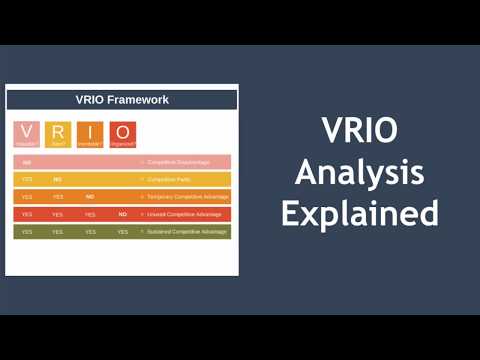
The cleanest single explainer: builds VRIO up from the resource-based view, walks each gate in order, and ends on the competitive-implications table you should be reciting in a case.
VRIO Analysis Explained
EPM
Short, well-produced walkthrough with a worked example plus an honest section on the framework's advantages and limitations, useful if an interviewer challenges the tool itself.
Internal Analysis: The VRIO Framework | Strategic Management | From A Business Professor
Business School 101
Lecture-style treatment from a business professor that positions VRIO inside internal analysis and explains why it complements rather than replaces industry analysis.

The VRIO Analysis explained
Sim Institute
A quick, plain-language refresher of the four questions and the decision tree, good for a five-minute review the night before an interview.
Go deeper
VRIO Framework Explained
Strategic Management Insight
The best free step-by-step guide: definitions of each criterion, the full competitive-implications table, the three imitation barriers, and a practical process for running the analysis on a real firm.
VRIO / VRIN Analysis Explained
Umbrex
Written for practising consultants: covers the VRIN-to-VRIO evolution and gives a ten-step application sequence from inventorying capabilities to gathering the economic evidence that a resource is genuinely valuable.
VRIO Analysis: Evaluating Resources Strategically, with Examples, Critique, and the Barney-Porter Bridge
SI Labs
The most intellectually honest write-up: it reports how modestly VRIO-qualifying resources actually explain performance differences, addresses the tautology and measurement critiques, and shows how to combine VRIO with Porter's external analysis.
Resource-Based View
Wikipedia
Free background on the theory VRIO sits inside, including resource heterogeneity and immobility, the original VRIN criteria, and the academic debate around them.
Firm Resources and Sustained Competitive Advantage (Barney, 1991)
Semantic Scholar
The original paper's landing page with abstract, citation graph, and links to accessible copies. Skim it once so you can cite the source correctly and understand why substitutability was part of the original test.
Now use it on a real case
Reading a framework isn't the same as applying it under pressure. Practise with an AI interviewer that pushes back.
Practise a case free